Putting education to use through research
Grace Ferguson ’27 planned to spend the summer working alongside curator Leah Niederstadt to care for objects in Wheaton’s Permanent Collection. She didn’t expect the experience to change her career aspirations.
“I’ve fallen in love with this work,” said Ferguson. One of four student research interns who collaborated with Niederstadt this summer, they gathered museum collections experience while maintaining items in the 10,000-piece collection.
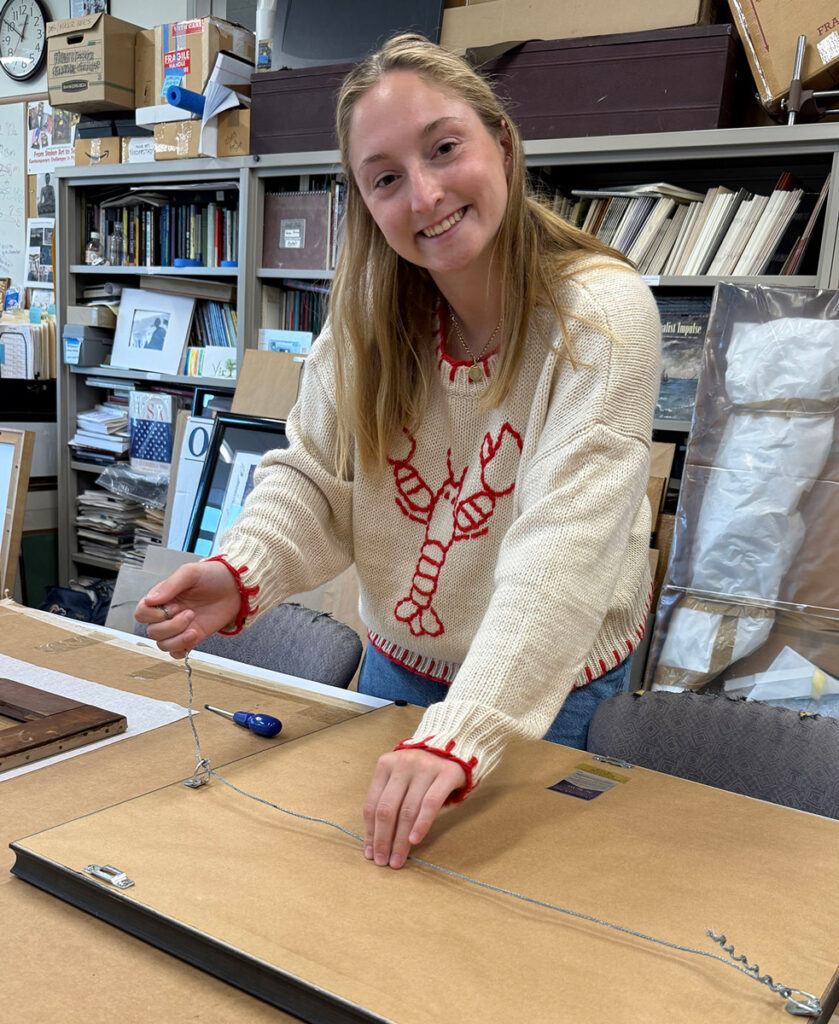
“I love history, so handling and helping preserve historical objects is very cool,” said the history major from Williston, Vt. “Working with Leah has changed my career path. I thought I wanted to pursue a Ph.D. in history to become a professor, but now I want to work in museums.”
Across virtually every discipline, Wheaton students benefit from similar experiences working closely with faculty on research, scholarship and creative projects. They build practical skills to deepen academic interests and reveal new possibilities for post-college pursuits.
“Research is the only way in which students can really apply deep disciplinary learning into unique projects of investigation,” said Jonathan Millen, provost and vice president for academic affairs. “I would argue that, more than any other enterprise in higher education, it’s research with faculty that puts the education to use. And Wheaton faculty excel at offering those opportunities to students.”
During the 2025–2026 academic year, 133 students engaged in research projects with a faculty member through independent study, a senior thesis for the Honors Program, research partnerships or faculty-student summer projects.
Here we highlight three research collaborations that took place this summer.
Discovering where an interest can lead
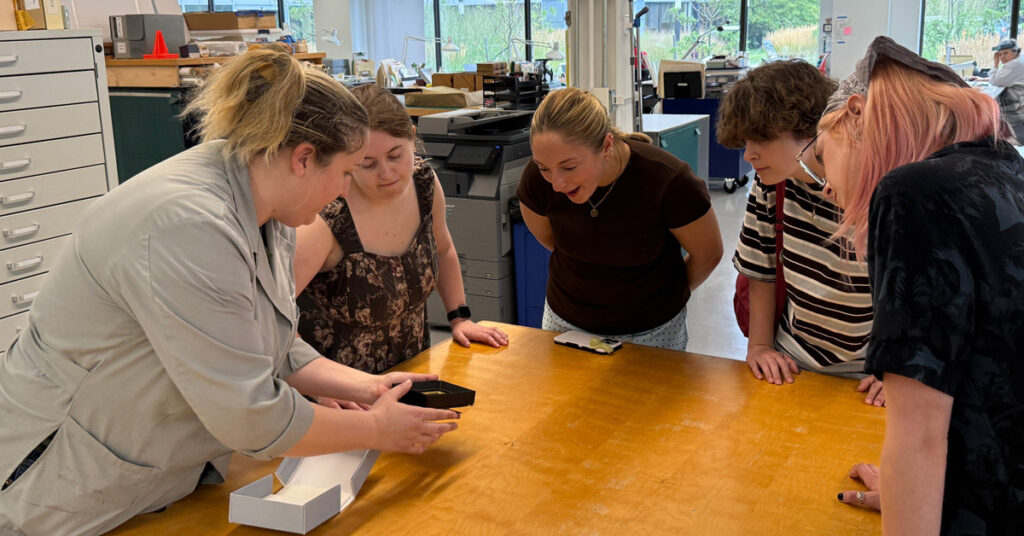
Summer interns in the Permanent Collection process objects, enter items into the database, conduct inventories, rehouse objects and assist with campus displays. Their work helps preserve Wheaton’s 10,000-piece collection and ensures that students can access objects during the academic year, when the Collection Study Room hosts up to 30 visits each semester.
For Niederstadt, who also serves as associate professor of museum studies/history of art, the close collaboration is one of the most rewarding aspects of working with students.
“I really enjoy working directly with the students, mentoring and advising and getting to know them more closely through summer internships,” she said. “They strengthen students’ sense of belonging to the Wheaton community. The experience can help them get other internships while enhancing their grad school applications and their ability to get jobs in the field.”
That connection between academic interests and career possibilities is especially valuable in fields such as galleries, libraries, archives and museums (GLAM), where practical experience can be an important part of preparing for a career.
Students interested in the field can complete a GLAM experiential minor at Wheaton.
“Wheaton’s new experiential minors provide students with both knowledge and skills,” said Niederstadt. “The challenge of the GLAM sector is you need to have hands-on experience to get a job beyond an administrative assistant, or a gift shop or front desk worker.”
Pressed for time as the field hockey team’s starting goalie, Ferguson hopes to continue working with Niederstadt during the academic year and rearrange her schedule to complete the GLAM experiential minor before she graduates. She also plans to explore master’s programs in history and museum studies.
Building skills that travel beyond the classroom
The value of research extends beyond a particular career field. Students develop habits of investigation, communication, problem-solving and collaboration that can serve them in graduate school and in a wide range of professions.
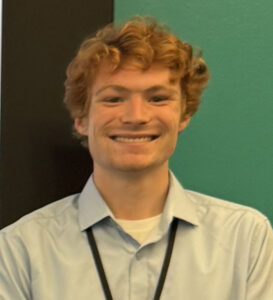
Lucas MacKenzie ’26 discovered that firsthand when he worked in the Permanent Collection for two years after taking a Museum Studies course with Niederstadt as a sophomore. The investigative nature of the work helped prepare him for Suffolk University Law School, where he started this fall.
“The work that I did with Leah—in terms of research, close reading, note-taking, and the practical experience of working with real objects and cases—I found more useful than a traditional class assignment,” said MacKenzie.
Just as important, he said, was the relationship he developed with his faculty mentor.
“That’s part of what’s amazing about Wheaton. By making a connection with a faculty member and working on a project together, we got to know each other very well, even though she was outside of my major. It was a great opportunity to make a lasting connection.”
That combination of mentorship, responsibility and practice can help students see themselves as professionals before they graduate and give them greater confidence in what they can contribute.
Turning academic questions into discovery
For neuroscience major Juliana Cooper ’27, conducting research provided both a deeper understanding of her academic interests and an opportunity to experience how scientific discovery actually happens.
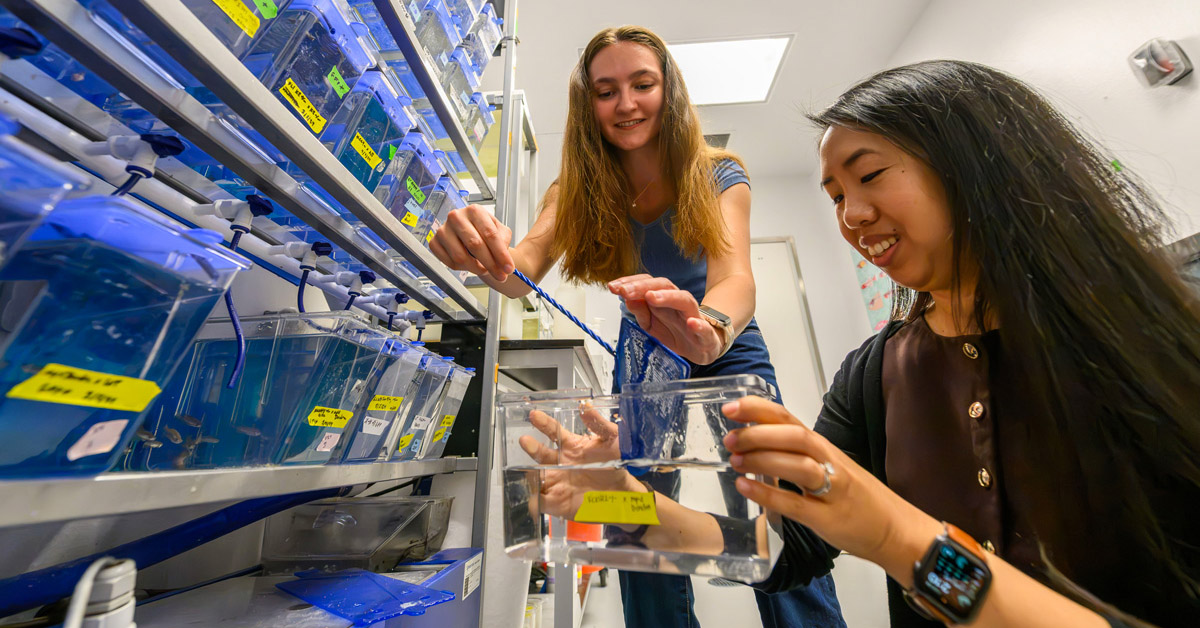
Cooper spent the summer studying zebrafish to better understand how environmental contaminants may interfere with their remarkable ability to regenerate damaged sensory cells.
“Ever since high school I’ve loved genetics and learning more about the unknowns through research,” said Cooper, a Cranston, R.I., resident. Her previous experience extracting perfluoroalkyl and polyfluoroalkyl substances (PFAS) from samples in a wastewater treatment lab fueled her interest in the project.
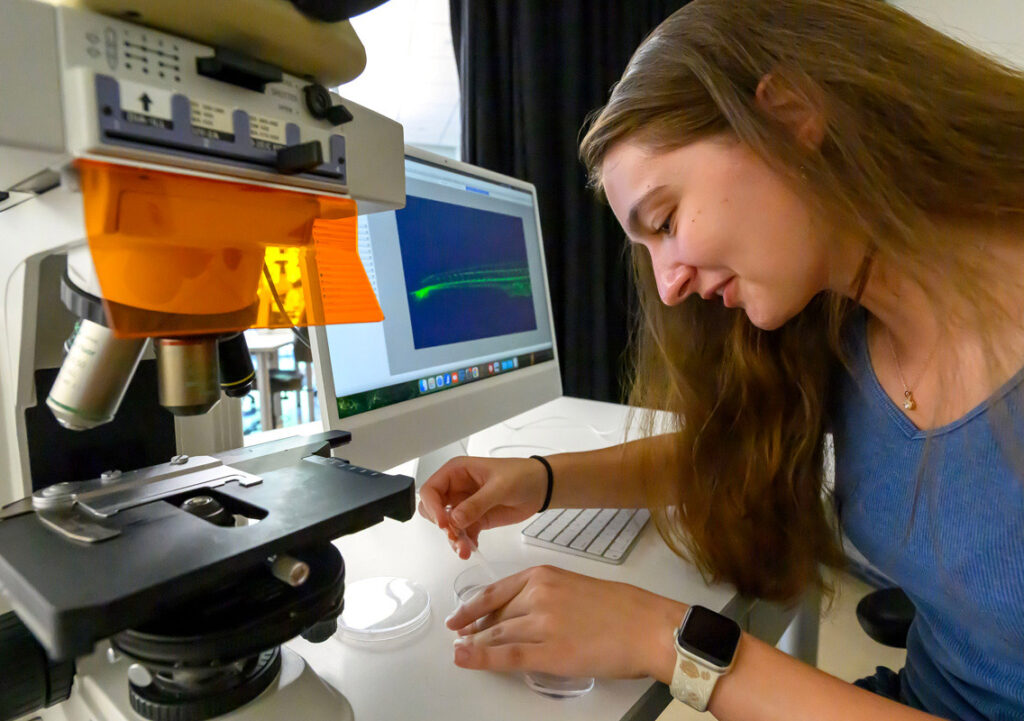
Working with Stacy Nguyen, professor of the practice of biology, Cooper conducted preliminary research for her honors thesis. Their work examines how exposure to PFAS affects the regeneration of neuromasts in the zebrafish, addressing a gap identified through an extensive literature review.
“Neuromasts allow fish to detect water movement, orient themselves in their environment and locate prey,” said Nguyen. “By examining how well these sensory cells recover after injury, we hope to better understand whether PFAS exposure interferes with normal regenerative processes.”
Cooper’s experience this summer has made the research process tangible. Dedicated time with Nguyen and weekly goals have allowed her to see that scientific progress is rarely linear, and often changes direction.
“For students, this type of experience provides a more realistic understanding of how research develops over time, including the problem-solving, troubleshooting and revision that are essential parts of the scientific process,” Nguyen said.
The work has also strengthened Cooper’s poise in the laboratory.
“Overall, I’ve learned about zebrafish husbandry, breeding and experimentation, and I feel much more confident working in the lab because of Professor Nguyen’s mentorship,” she said.
Nguyen sees those skills as preparation for a range of future opportunities.
“Juliana is developing skills in experimental design, scientific communication, data interpretation and independent problem-solving that will be valuable in many scientific and health-related careers,” she said.
Cooper will continue the project through the fall, complete her research and present her findings next spring. After graduation, she hopes to work in a research laboratory or as a medical laboratory scientist.
“I am passionate about any hands-on work that I can see direct results from,” she said.
Creating opportunities through research
Research can also open doors to questions and fields students may not encounter through traditional coursework.
For design major Shaye Ko ’27, a conversation with a professor after class led to a summer project examining how designers are educated.
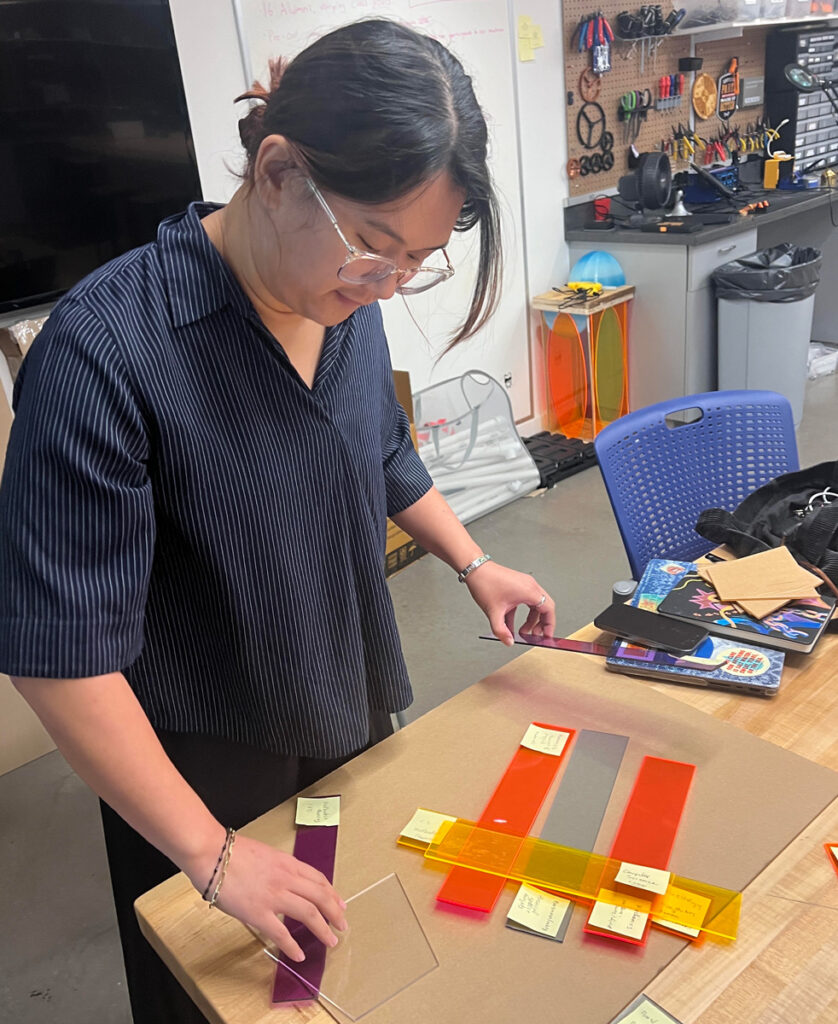
Ko, who is from Manila, Philippines, worked with Tania Schlatter, professor of the practice and design program lead, to create a framework that educators can use to compare, evaluate and design human-computer interaction (HCI) curricula.
HCI examines how people interact with digital technology, from websites and apps to emerging AI systems. Ko became interested in the project after taking Schlatter’s Designing Information Environments course during the spring.
The course challenged Ko to think about design as a form of research and investigation—and about how design might address future problems rooted in present-day reality.
“I wanted to apply my design skills to questions about what future designers need to know,” said Ko. “A discussion after class with Prof. Schlatter led to her research, which tries to describe what students need to know in the closely related field of HCI design.”
The experience has broadened Ko’s understanding of what it means to learn and to educate.
“I’ve learned a lot about what it takes to create knowledge both independently and as a team, and what it means to be responsible for it,” she said.
After graduating in the spring, Ko plans to develop and refine her skills in the Philippines while exploring continuing education or design research opportunities.
Schlatter said the summer research experience allows students to extend their learning beyond the boundaries of the formal curriculum.
“Students experience how their classroom learning applies in broader scholarly and creative practice, and take an active role in that application,” she said. “The work typically involves a variety of skills beyond creative design, such as research and analysis.”
Together, Ko and Schlatter examined how HCI has evolved and designed a tool to help educators consider and visualize its transdisciplinary nature. The purpose is to help educators collaborate and define curricula to prepare the next generation of designers.
Ko said her research with Schlatter has given her a new perspective on what the future holds.
“Attempting to model a core curriculum for HCI design helps us to understand the kind of designers that will exist in the future, and who will play a part in influencing future technology and society,” she said.