Building ethical responsibilities in business
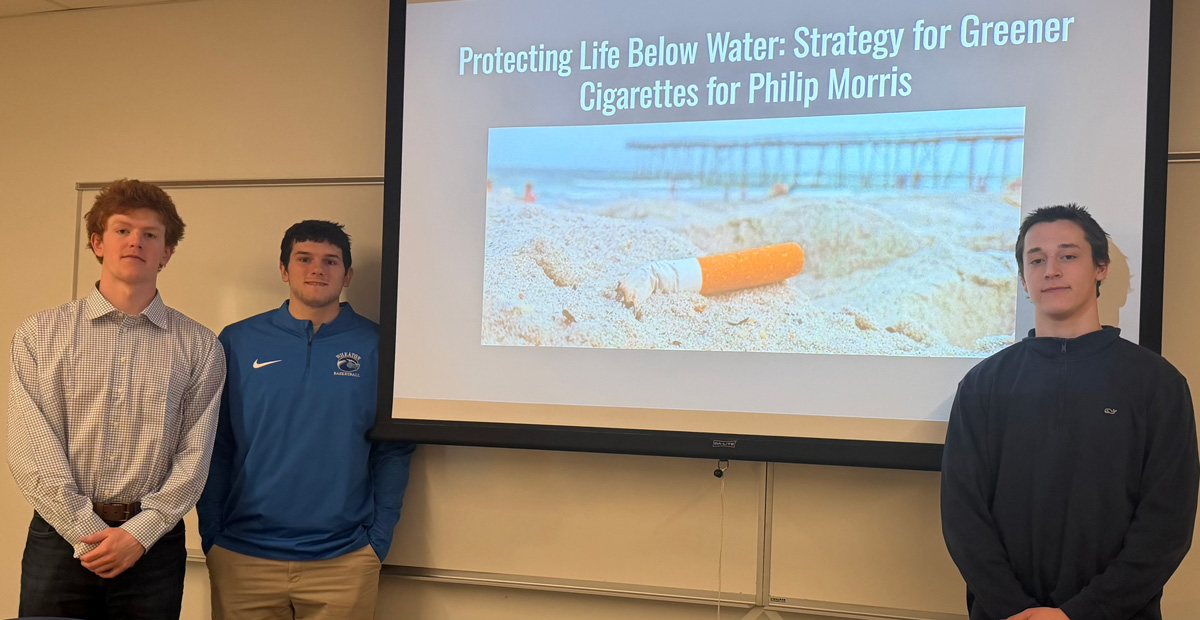
A team of Wheaton students placed fourth in an international business ethics competition, where they presented a potential solution to a longstanding problem: discarded cigarette butts.
Sponsored by Loyola Marymount University in Los Angeles, the International Business Ethics and Sustainability Case Competition welcomed 59 teams representing 41 colleges and universities from seven countries.
The Wheaton team—Jack Kenyon ’28, Jimmy Ciummo ’28 and Rex Zadrozny ’28—collaborated on the project as part of a new initiative in the Business Management and Responsibility course (MGMT 210), taught by Jeanne Girard, professor of the practice of business and management.
The students aimed to tackle the tide of cigarette butts, a notorious problem on Rhode Island beaches, according to Kenyon, a Westerly, R.I., resident. The 2025 International Coastal Cleanup administered by Save the Bay removed nearly 21,000 cigarette butts from the state’s beaches. An overwhelming majority of cigarette filters are not biodegradable.
“Our project focused on the ecological damage being done rather than the impact on health, which is generally spoken about the most,” said Kenyon. The students created a fictitious consulting group and selected Philip Morris International as its client. With more than $38 billion in sales in 2025, Philip Morris is the world’s most profitable tobacco company.
The team’s solution was to establish a buyback program with collection centers at marinas, commercial fishing ports, and parks that are on the water. By partnering with TerraCycle (a global leader in recycling) collected cigarette butts would be manufactured into materials that could be reused.
Classroom discussions also helped to inform the proposal. “We had a class focused on the concept of greenwashing, what it was and where it occurred,” said Kenyon. “Afterwards, we included this piece in our legal analysis of the project as another example of wrongdoing that Philip Morris could have been held accountable for.”
To support their proposal, the students conducted extensive research, developed a plan and created a presentation.The students researched the lawsuits faced by Philip Morris and others faced when they were held responsible for lung cancers and health issues to explore parallels to the marine debris issue, said Girard.
“They identified the risk of the cigarette filter, explained why it was unethical and created a business solution to fix it,” said Girard. “The purpose is to explain to the company why it’s beneficial to act ethically, and that it will reduce costs and could save them from potential lawsuits.”
The team participated virtually in the competition. Following an initial 25-minute presentation, Girard believes that the team won over the judges during a 15-minute Q&A session. “The judges had some great questions and because the students had done extensive research they were able to answer any question thrown at them,” she said. The final competition task was a 90-second elevator pitch explaining the importance of one or more of the United Nations Sustainable Development Goals.
Because the students addressed the parameters identified in the judging form—social responsibility, as well as financial, legal, ethical and philanthropic implications—their project was recognized as a runner-up. “They did amazing,” Girard said. “And the team loved the experience of competing.”
Students also appreciated venturing beyond case studies and textbooks to engage with issues that businesses today may face. “We gained hands-on experience with a real-world problem that might be overlooked in the industry,” said Kenyon, a business and economics major. “I really enjoyed the opportunity to produce a proposal that could be implemented.”
Kenyon will spend his junior year at the University of Oxford. “I’m excited to study economics and politics at one of the most prestigious universities in the world, and I wouldn’t have been able to do so without the education and guidance I received at Wheaton College.”
Overall, 10 teams of students from two sections of Girard’s course worked on these types of independent projects, which will be submitted to the companies they selected as clients, explaining that it’s a student project that aims to identify a true risk.
“I wanted the students to believe in the importance of the project and to see that they could be business ethical leaders,” she said. “These companies need to start solving some of the problems that they’ve created and we have to show them that doing so is good business.”