Good and evil
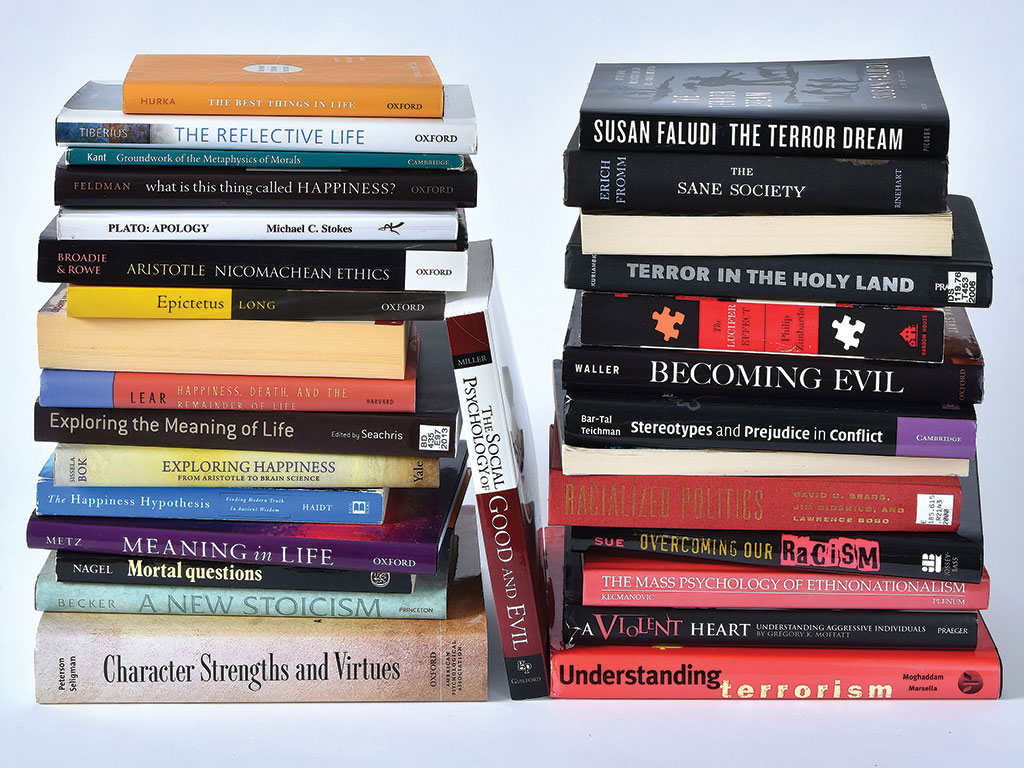

In 2011, Associate Professor of Philosophy John Partridge won a grant from the National Endowment for the Humanities Enduring Questions Program to develop a course around a timeless question. Having taught a Senior Seminar course on the meaning of life during the past several years, a question came to mind: What does it mean to have a good life? In fall 2017, Partridge explored this in his First-Year Seminar (FYS) “What is the Good Life?”
Professor of Psychology Gail Sahar had been considering teaching a course on how good people become capable of carrying out evil acts for a while before designing the FYS “On Becoming Evil” several years ago. In fall 2017, she taught the FYS that, unfortunately, always has plenty of current examples from which to draw.
Offered at a pivotal period in the lives of incoming students, both courses engage them in critically evaluating arguments, assumptions and theories on big, timeless questions about life and human nature, while reflecting on their own values and choices. We found the contrast in subject matter—the good versus bad, dark versus light—intriguing and asked both professors to tell us about their courses.
By John Partridge
By Gail Sahar
By John Partridge
In my research I have explored Socrates’s assertion that “the unexamined life is not worth living.” He thinks that persistent examination, or philosophy, is the highest value. It gives him happiness (eudaimonia) to “care for the soul” in this way. I’ve tried to make sense of that claim but it’s not easy.
First, his concept of happiness is not the same as ours. Second, his insistence that there is a single, highest activity that is best for everyone seems gravely mistaken. >>>>
By Gail Sahar
I originally came up with the idea for this First-Year Seminar “On Becoming Evil” several years ago. After news stories broke about U.S. soldiers torturing Iraqi prisoners during the Iraq War, I started thinking about how it is that seemingly normal, healthy individuals can, under certain circumstances, become capable of carrying out horrible (even evil) acts.
These cases always come down to the question of whether there are a “few bad apples” who do evil things when they find an opportunity or whether there were influences in the situation that made “good apples” do bad things. >>>
Oct 22, 2026