
Woven stories, lasting voices
An alumna’s art connects histories of incarceration, displacement and belonging
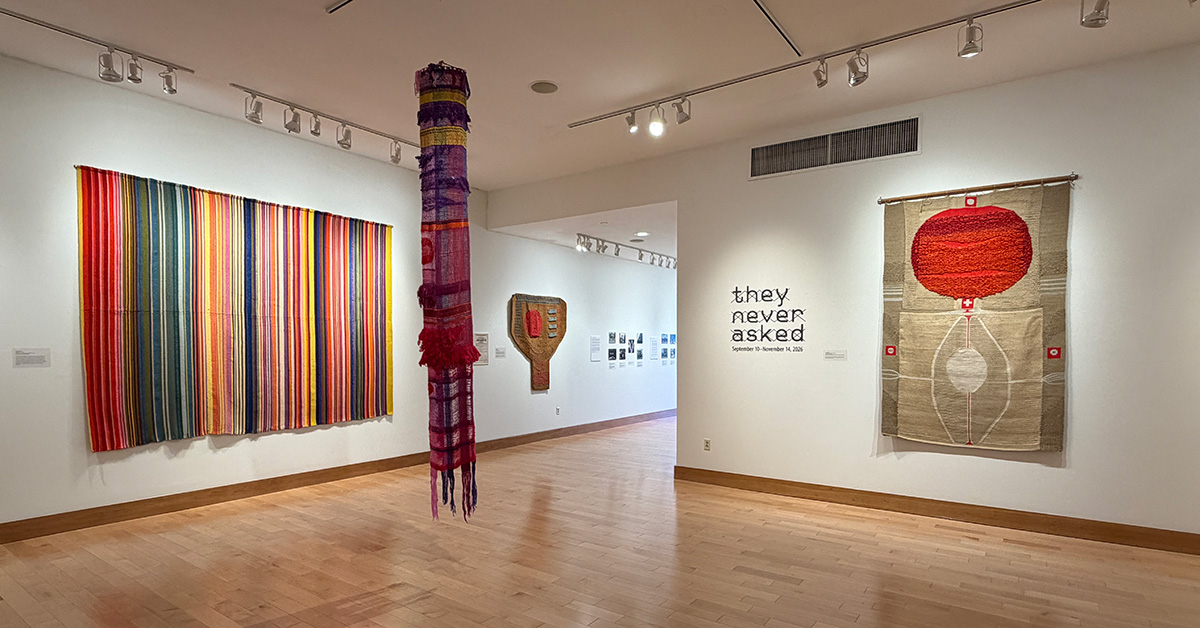
Colorful columns of cloth hang in the front of the gallery, conveying a warmth that contrasts with the painful history behind their creation.
The hand-woven artworks show the skill and the spirit of artist Momo Nagano ’47, whose artistry in weaving can be traced back to her incarceration at a Japanese internment camp during World War II.
“The fact that she lived through this injustice but created work with such hope and creativity and color is really powerful to see,” said Avery Adams ’30, one of hundreds of visitors to the exhibit “they never asked,” which is on display in Wheaton’s Beard and Weil Galleries through Nov. 14.
Nagano’s art and life anchor they never asked, an exhibition that examines the history of racialized immigration enforcement and confinement in the United States. Through artwork, photographs, documents and personal stories, the show connects national policies to individual experiences—and gives Wheaton students across disciplines a place to explore their implications.
For gallery director Elizabeth Hoy, Nagano’s connection to Wheaton offered a way into a subject whose scale can make it difficult to comprehend.
“Bringing it back to the story of this Wheaton alum humanizes it and localizes it, and helps us learn through her experience and her story,” Hoy said.
Life woven into art
Following President Franklin D. Roosevelt’s signing of Executive Order 9066 in 1942, Nagano and other members of her family were incarcerated at Manzanar, where she graduated with the first class of Manzanar High School.
With her family’s support and permission from authorities to leave, she enrolled at Wheaton, which provided a scholarship. She graduated in 1947 with a degree in history.
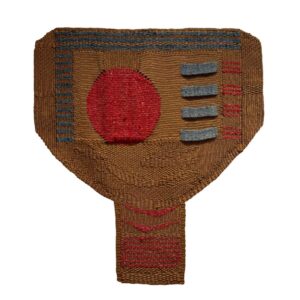
After returning to Los Angeles, Nagano studied ceramics, married and raised four children as a single mother. A weaving class in 1964 reminded her of the satisfaction she took from working in a factory at Manzanar that made camouflage nets. She decided to make weaving and textiles her primary artistic medium. Her work, which has received widespread acclaim, is now part of museum, corporate and private collections. Nagano’s weavings are even owned and displayed by the National Park Service, which maintains Manzanar as a national historic site.
Editor’s note: Read more about Nagano in An American Story, published in the Wheaton Quarterly, December 2000.
While Wheaton awarded Nagano an honorary Doctor of Fine Arts degree posthumously in 2022, the exhibition marks the first time that her artwork has been displayed at the college. Working with Nagano’s family, Hoy assembled nine pieces, including one borrowed from the National Park Service at Manzanar. Nagano’s son, performance artist Dan Kwong, helped arrange the loans and drove to Manzanar to collect that work for shipment to Massachusetts.
Her family also gave Wheaton one of her textiles, fulfilling a wish Nagano had held during her lifetime.
“It means a lot that her family made that happen,” Hoy said.
The scale and variety of the works allow visitors to encounter Nagano as an artist as well as a historical figure. Some textiles extend from floor to ceiling, creating an immersive experience.
Alongside them, photographs by Dorothea Lange and Ansel Adams document the wartime incarceration of Japanese Americans. Nagano’s family identified her in a Lange photograph showing workers weaving camouflage nets, documenting the connection between Manzanar and her artistic practice.
Learning across disciplines
Other artistic responses to past and present immigration issues in the U.S. broaden the exhibition’s scope. Mapping Deportations uses documents, photographs and data visualization to examine the history of exclusion and deportation. Index of the Disappeared explores surveillance and detention following September 11, 2001. Another project examines the history of immigration detention in Rhode Island.
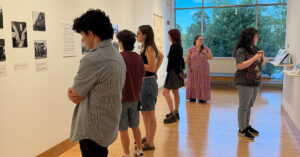
Altogether, the works invite visitors to consider how government policies shape lives, whose experiences enter the historical record and how art can preserve stories that might otherwise be overlooked. For Wheaton students, the show also offers an opportunity to examine how art, historical documents and data convey experiences of displacement and belonging.
Avery visited the gallery with Professor Barbara Darling and classmates in the First-Year Experience course, “Right and Wrong, Life and Death,” a discussion-based class that examines various sides of contentious topics.
After a tour of the exhibit, the students browsed the displays, examining the photos from Manzanar, the Wheaton yearbook from the year Nagano graduated, documents from recent immigration proceedings and historical records on immigration and the controversies that it has evoked over the years.
Professor Dennis Kalob’s brought students in the capstone course for the Criminal Justice, Restorative Justice and Criminology program for a tour of the exhibition and a discussion that connected the display with the class’s examination of current events, immigration enforcement and detention. With students developing their capstone research topics, the exhibition offered potential directions for their research projects.
Students in Professor Karen McCormack’s course “Telling Stories with Data” responded to Nagano’s artwork as well as the larger tapestry on immigration and injustice that the exhibition wove together from documents and data, photographs and video, and the personal testimonies of immigrants.
In brief reflections on the visit, students compared and contrasted the exhibit with one of their course readings, the Pulitzer Prize-winning book Evicted: Poverty and Profit in the American City (2016). Both tell nuanced stories about complex issues through a mixture of personal experiences, art and data.
“In Evicted, a home isn’t just a building, it represents security, family, relationships and a sense of belonging,” said Aubrey Collier ’28. “Similarly, weaving isn’t just thread put together to create a pattern. It can represent history, cultural identity and connections between people and generations.”
Eva LeCompte ’28 said that Nagano’s artwork “represented an act of reclamation.”
“Momo used what she learned to create pieces that represented her story. She was able to speak volumes, despite not using words at all,” LeCompte said. “Even following her passing, the art she made lives on and continues to tell her story.”