
An American Story
The remarkable life and art of Momo Nagano ’47 weave a tale of pain and resiliency
Originally published in the Wheaton Quarterly, December 2000
By Lin Johnson Weber ’67
Between the longitude of belief and the latitude of chance, between the warp and the weft, we create a tapestry of life. In the life of weaver Momo Nagano ’47, her fabric has been woven of blessing and travail, tradition and surprise. From the dusty roads of Manzanar to the gleaming hallways of California’s state Capitol, Nagano knows well the metaphor of warp and weft; she is a weaver whose art has been honored for the cultural tale it weaves.
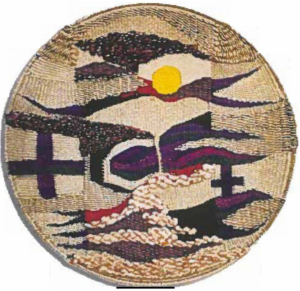
Last year Nagano’s unusual story and the quality of her work attracted the attention of California State Senator Adam Schiff, chair of the California Joint Committee on the Arts. He selected one of her works-an untitled abstract weaving in linen and wool-for inclusion in the Year 2000 California State Senate Contemporary California Art Collection.
“Her weavings,” Schiff said of Nagano’s work, “are a testament to her remarkable resiliency, courageous spirit and enduring love for California in the face of tremendous adversity.”
Indeed, Nagano’s story is remarkable.
Nagano is a Nisei, a second-generation Japanese-American. Her father, Kiro Nagano, immigrated to America around 1918. After a brief stay at the University of Washington, he made his way to Southern California, where he became a farmer. He eventually had a thriving business in the wholesale produce market, despite the strong anti-Asian prejudice that had long been part of California’s social history. A natural leader with a commanding physical presence, he advocated for others who were similarly persecuted. He returned to Japan briefly in 1920 to marry Ai Enoki, a sister of his best friend, and sailed back to America with his bride the day after their wedding. Eventually they had three children-Daisuke, Momo and Aiji-and seemed well on their way to achieving the American Dream.
The Naganos achieved a pivotal part of the dream in 1941: home ownership. Exclusionary laws in California limited where Asian immigrants could live and what they could own. Issei (first-generation immigrants) were ineligible for American citizenship and could not own land. Nisei, by virtue of their American birth, were allowed to own land if they could find someone willing to sell to them. Kiro Nagano purchased a lot in Los Angeles in oldest son Daisuke’s name and began building a home for his family. The house-a handsome structure built of California redwood-was to be completed in January 1942.
Adversity and inspiration
The morning of Dec. 7, 1941, changed everything. Japan launched its surprise attack on Pearl Harbor and propelled the U.S. into the Pacific theater of World War II. That evening there was a knock at the family’s front door. Nagano remembers it vividly.
“My younger brother, Aiji, and I were already in our pajamas, and we went to answer the door. Two FBI agents in fedoras and overcoats were standing there. They brushed by us and came right into the house. One agent went into our parents’ bedroom and ordered our father to get up and get dressed; the other searched the house. They took the family’s Brownie camera, Daisuke’s prized .22-caliber rifle and all letters written in Japanese.”
 The agents marched Kiro Nagano away into the darkness. For the duration of the war he crisscrossed the western U.S., shunted from one detention camp to another-Montana, Oklahoma, Louisiana, New Mexico, California and, finally, Colorado. Daisuke Nagano left school to support the family.
Then came Executive Order 9066, issued in February 1942 by President Franklin Delano Roosevelt. The order gave the War Department the authority to remove certain people from American “military areas;” by March those areas were defined as the states of Washington, Oregon, California and much of Arizona. Any person identified as being at least one-sixteenth Japanese was targeted for removal. Virtually every Japanese-American living on the West Coast was considered a possible threat to U.S. security. On April 2, 1942, Nagano, her mother and her two brothers “voluntarily” evacuated Los Angeles. They left behind almost everything, except for the few things they were allowed to take to the camp. “We just walked away from our new house, not knowing if we would ever return,” she recalled.
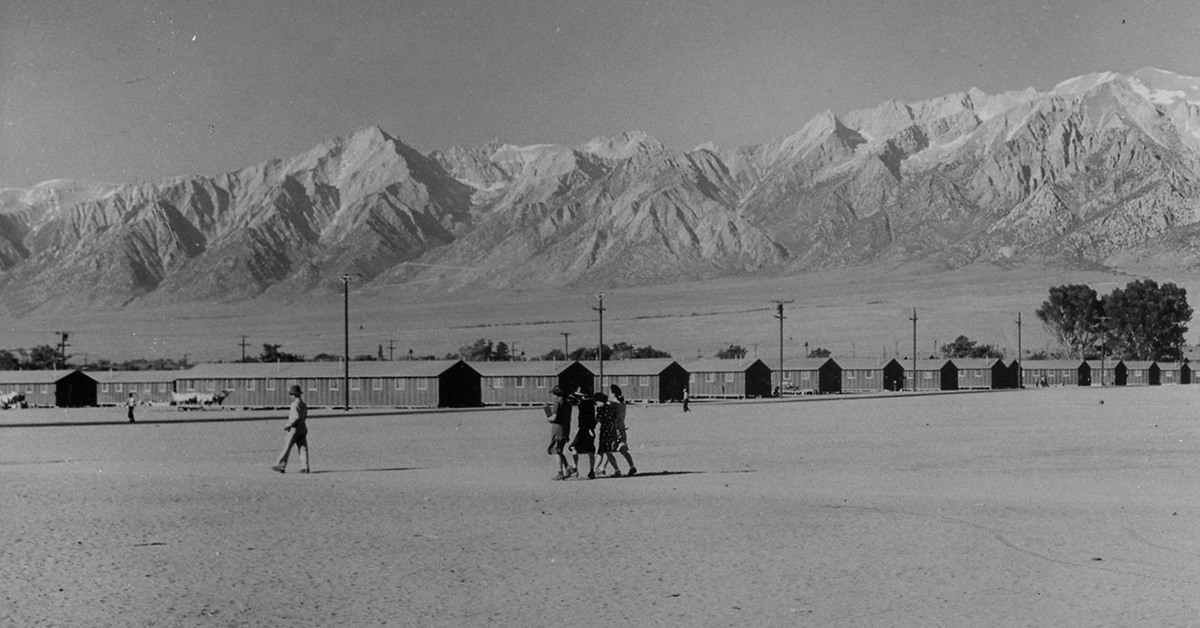
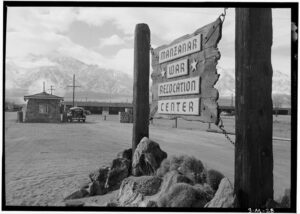
The familiar pattern that had been Nagano’s life for 16 years was abruptly altered. Now home would be in a place called “Manzanar,” an internment camp in the California desert near Death Valley. Manzanar was only partly completed when the Naganos arrived, and would eventually house 10,000 Japanese-American internees.
“My heart sank when I saw where we’d be living,” Nagano recalled. “There were rows and rows of tar-papered barracks. We were assigned to a room, which we were to share with another family, and the two families suspended a sheet from the rafters to give ourselves some privacy. Like the other evacuees, we were given bags of mattress ticking and told to fill them with straw. This was to be our bedding.”
U.S. soldiers armed with rifles walked the barbed-wire perimeter of Manzanar, beneath watchtowers with searchlights that crisscrossed the camp at night. Forbidden to leave, the internees at Manzanar and the nine other detention camps across the United States did what they could to normalize their lives. They organized craft classes and sports leagues; they sent away for seeds to plant gardens. When a facility for making camouflage nets was set up in Manzanar, Nagano went to work.
“Though the project did not last long, I found that I loved the process of weaving burlap strips through the netting,” Nagano told a Los Angeles newspaper. “Ironically, that may have influenced me to go into weaving seriously over 20 years later.”
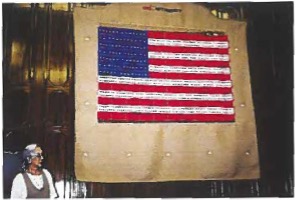
There is little doubt of the influence in Nagano’s recent work. Last year she received a grant from the California Civil Liberties Public Education Program to produce a large weaving-a tribute to the Japanese-American families from her neighborhood that were forced to leave their homes in 1942 and resettle in internment camps throughout the western United States. “American Families” depicts the American flag covered with the names of Japanese-American neighbors.
“The netting through which the stripes of the American flag are woven is a reference to the camouflage netting facilities… in some assembly centers and camps,” Nagano wrote in the “American Families” artist’s statement.
From Manzanar to Wheaton
When camp schools were established in October 1942, Nagano became a Manzanar High School student and graduated in the summer of 1943. Through the help of the American Friends Service Committee, a Quaker organization dedicated to helping the interned Nisei students obtain opportunities beyond the camps, Nagano and her older brother found a hint of freedom in higher education. Daisuke was allowed to attend Yale University, where he earned his bachelor’s degree. Momo Nagano wanted to continue her studies as well and Wheaton, unlike several other schools, was happy to invite her to Norton.
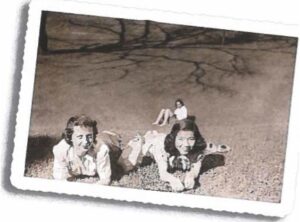
Nagano had one more task before she embarked to New England in the summer of 1943. Her father remained separated from the family at an internment camp in Santa Fe, New Mexico, and Nagano was permitted to speak on his behalf at a hearing. A non-Japanese “escort” accompanied her through California and, at the hearing, she persuaded the panel to allow her father to join her mother in Manzanar. In February 1944, with her parents finally reunited, Nagano began her journey to Norton.
Nagano traveled first by train to New York City, where she met her brother. Together they continued to Norton, arriving at Wheaton by taxi late at night.
“I waved goodbye to him and waited in the cold and dark until my new junior big sister, Joyce Cooper Haase ’45, came to escort me to my room on the second floor of Everett dormitory,” Nagano remembered. A gauntlet of curious girls stood in their doorways to see the new Japanese student.
At Wheaton the weft of Nagano’s life took on a new strand. Having spent the first part of her life in the relative security of the Japanese-American community in Southern California, she had to adjust to a different life as one of the few Asian American students on campus. Indeed, she says she was the first Japanese-American most Wheaton students had ever seen. In time, she made friends and began to feel at home.
Nagano’s parents left Manzanar in 1945. They were relocated to a camp in Denver, where they lived for a year before being allowed to return to their Los Angeles home. She spent her first two summer vacations from Wheaton reincarcerated in Manzanar. She graduated in 1947 with a degree in history.
Nagano had planned to continue her schooling at Columbia University, wanting to earn a graduate degree in journalism; but her father, longing to have his family together again, urged her to return to Los Angeles. She moved back to the redwood house she was forced to leave some five years earlier.
Returning to Southern California, Nagano turned her attentions back to the American Dream. She married and had four children-Maria, Daniel, Diana and Barbara-whom she raised as a single parent after her divorce. She proudly states that all of her children went on to earn their college degrees. Education, the prize that had lured Kiro Nagano to America in the first place, continued to be highly valued in the family that daughter Momo raised.
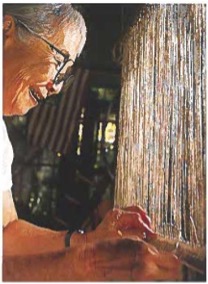
The new pattern that would be Nagano’s life work began to emerge in the 1960s. She studied ceramics at a local art school and began to work as a potter. In the pages of a library book on Navajo weaving Nagano found a new inspiration, which she cultivated with classes at Los Angeles’ Barnsdall Arts and Crafts Center.
“While others in my class were making place mats and baby blankets, I was constructing wall hangings,” she recalled. After a year, she was asked to teach weaving classes and she hasn’t stopped teaching yet. For eight years she taught weaving at Immaculate Heart College in Los Angeles. Nagano also has conducted weaving workshops statewide, volunteered for the Artmobile program in inner-city schools, and most recently served as administrator of the gallery of the Japanese-American Cultural and Community Center in Los Angeles.
In this position Nagano has not only served the Japanese-American community; she also has used it as a vehicle to augment a cultural education cut short so many years ago. She has learned a number of traditional Japanese arts, such as the tea ceremony, flower arranging, Okinawan stencil dyeing and netsuke (miniature sculpture).
As Nagano said in a recent interview, “The more you learn about something, the more you can appreciate it.”
Lin Johnson Weber ’67 is the author of Old Napa Valley: The History to 1900.