
Turning coursework into a conference presentation
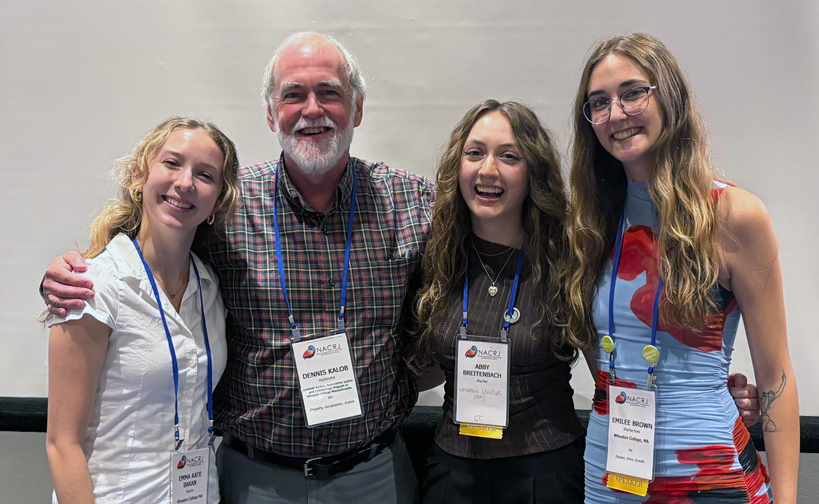
When Professor Dennis Kalob asked Emma Baran ’27 to help promote Wheaton College’s criminal justice program at a national conference, she saw an opportunity to do more than describe what she had learned.
“What if I did my own research?” she said. “Then I could show what I’ve learned.”
Kalob agreed. Baran drew inspiration from the guest speakers and discussions that took place in Professor Kalob’s Restorative Justice course to conduct her own research and develop a plan on how a rehabilitative approach to criminal justice could be implemented more broadly in the U.S.
In July, Baran presented the project, “Implementation of Restorative Justice in the United States,” to students and professionals at the National Conference on Community and Restorative Justice.
She was not the only Wheaton student to present research at the conference. Classmates Abby Breitenbach ’26 and Emilee Brown ’26 also spoke at the national gathering of professionals and scholars.
Restorative justice—one field explored as part of Wheaton’s criminal justice, restorative justice and criminology program—seeks to address harm by bringing together victims, the people responsible for causing harm and the wider community to promote accountability, repair damage and restore relationships where possible.
“Once a restorative justice plan is completed, if the victim feels better, and the offender apologizes and recognizes what they did, the matter is resolved,” said Baran. “It’s an alternative to sending offenders to jail. I hoped that my plan would help people choose a restorative route.”
Baran’s interest in taking a deep dive into expanding restorative justice in the U.S. arose from Kalob’s course, which included a number of guest speakers who are practitioners in organizations such as the Transformational Prison Project and The Petey Greene Program. Hearing about their experiences and observations in the field whetted the criminal justice, restorative justice and criminology major’s interest in learning more about the approach.
“It was more than just lecturing about restorative justice,” Baran said. “He brought people in to teach us and help us understand what it’s all about. So I was very excited and eager to do my research on restorative justice.”
Breitenbach also found the speakers profoundly impactful.
“Each of the guest speakers provided valuable lessons on how restorative justice practices had either healed them, or actively worked to heal our community,” said Breitenbach. “Hearing their perspectives and experiences changed the way I viewed restorative justice healing. It made it real.”
The speakers supplement the course, which explores the concept of restorative justice and what it aims to accomplish.
“The value of restorative justice in addressing, reducing/preventing and healing personal and social harm is best exemplified through the personal experiences of those who have been involved,” said Kalob, professor of the practice of criminal justice, restorative justice and criminology.
Creating a restorative justice plan
To create her implementation plan, Baran relied on fundamental principles from her courses and the results of her research. The CJRJC major from Raynham, Mass., completed the project for her Senior Capstone course last fall.
“In America, responses to crime concentrate on revenge, justice and punishment,” she said. “It’s hard for many people to think of the concept of something rehabilitative versus punitive.”
As part of her research, Baran reviewed the practices of three countries that had incorporated restorative justice into its system.

“New Zealand and Australia had formal implementation, mostly in the juvenile justice system,” Baran said, indicating that research has revealed that both systems were effective. “I believe that if it works for juveniles, it should work with adults who also want to rehabilitate and reenter society.”
Rwanda adopted a form of restorative justice to rehabilitate its communities after the country’s genocide in 1994. Baran shared that the system ultimately failed, due to corruption caused by bribery and the seizure of political power.
“The corruption created an extreme lack of due process, lack of impartiality, and a pardoning of crimes committed by the dominant political party,” she stated in her senior capstone paper.
The core of Baran’s plan involves mediated sessions at which the offender and victim meet to discuss the harm done and how to make amends.
“Once completed, if the victim feels better, and the offender apologizes and recognizes what they did, the matter is resolved,” she said. “It’s an alternative to sending offenders to jail and I hope it would help people choose a restorative route.”
Kalob and the students presented a session titled “Wheaton College Massachusetts: Building a Program with Restorative Justice at the Center” at this year’s national conference.
In addition to Baran’s project, Breitenbach and Brown presented their research project, “Understanding Restorative Justice in Massachusetts Carceral Facilities.” Both students volunteered as tutors for incarcerated youth at The Petey Greene Program, assisting them with their education while they built meaningful relationships with the youths.
“As tutors, we sat in classrooms and worked one-on-one, assisting the youth on subjects they needed help with,” said Breitenbach. “We also helped them write letters and study for their GED tests.
“We gained a better understanding on how restorative justice practices were working in this facility,” said Breitenbach, which enabled them to assess the tutoring program and recommend improvements to it.
Brown and Breitenbach recommended that with more engaging teachers and lessons, combined with assistance from tutors representing different colleges and exposure to the benefits of learning, the youths would gain interest in pursuing higher education.
“They have the motivations and qualities to incorporate restorative practices into their lives and positively impact their future,” said Breitenbach.
Reflecting on the experience
Overall, the students enjoyed attending the conference, where they were warmly welcomed and incorporated into the experience. Baran lauded its inclusive environment, where her passion for the field grew.
“I learned that I wanted to be more involved in restorative justice,” she said. “Making connections at the conference gave me confidence to talk to people that I don’t know, especially about my research.”
Planning to graduate a semester early, Baran is applying to graduate schools and hopes to pursue a master’s degree in clinical mental health counseling with a concentration in forensics and corrections.
Breitenbach, now pursuing a Master of Social Work at Syracuse University, appreciated the growth she experienced throughout her Wheaton education, and the support of her professors to prepare her for the future.
“My professors challenged me to push myself in critical ways that allowed me to bring authentic, thoroughly-developed ideas and writing to my classes,” she said.
Her hands-on experiences outside of the classroom helped connect lessons and theories to practice.
“As a current graduate student, I continue to practice connecting lectures to real-life while completing a practicum internship in the social work field,” said Breitenbach. “I am incredibly grateful for the lessons that my Wheaton education taught me, and more thankful for the amazing professors that gave me the space and opportunity to find my academic path.”