
Wheaton senior earns Psi Chi grant to advance research on childhood trauma and empathy
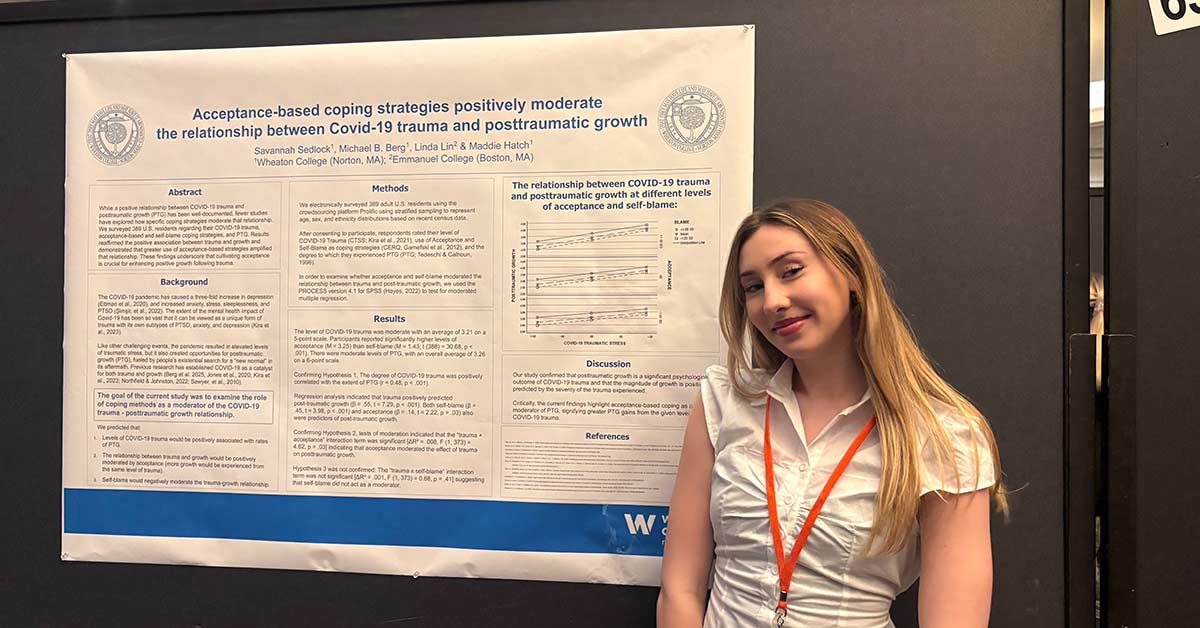
A Wheaton College senior has been awarded $3,600 from Psi Chi, the international psychology honor society, to support her research examining how children respond to trauma—and how those experiences may shape empathy and growth.
Savannah Sedlock ’26, a psychology and public health major from Fairfax, Va., is studying how prior experience with one or more traumatic incidents may influence the way in which children deal with others and with subsequent difficult situations.
“I’m really interested in investigating how children develop empathy,” Sedlock said. “My project looks at how children develop empathy and prosocial behavior—like sharing—depending on how much trauma they’ve experienced.”
Her honors thesis study combines parent surveys with in-person interviews of young children at the Wheaton College Early Education Center and Mansfield Children’s Center. Parents report the number of adverse experiences their child has faced, while Sedlock engages children in discussions about illustrated stories she created to assess emotional understanding and response.
“I interviewed 43 children … and I’m really excited to start coding the data just to see how everything will line up,” she said. “It’s been really incredible.”
Sedlock’s hypothesis is that children who have experienced more trauma may demonstrate heightened empathy and prosocial behavior—an idea rooted in prior clinical research and her own lived experience as the oldest of five siblings in a military family with a parent who would sometimes be away for long periods of time.
“I had to learn from a pretty young age how to regulate my brothers’ emotions and understand what was going on in their heads,” she said. “I’ve always been really curious about how that kind of experience shapes emotional development.”
The power of a grant
The Psi Chi funding has played a critical role in bringing the project to life. Sedlock used the grant to purchase software for creating her interview materials, provide small rewards for child participants, and support partner schools.
“It’s really important to me that the children are rewarded in some way for participating,” she said. “And I also wanted to give back to the schools and staff who helped make the study possible. They really went above and beyond.”
The grant will also help fund her continued professional development, including attendance at a national trauma conference in Boston this spring.
Sedlock’s advisor, Professor of Psychology Michael Berg, praised both the ambition and execution of the project.
“Savannah has gained an extensive background in her thesis area through previous internships and attending conferences,” Berg said. “She has pulled the entire study together on her own, devising a parent survey and conducting in-person interviews with over 40 children. She is an incredibly focused and driven individual, and her ambitious thesis reflects that.”
Berg also noted Sedlock’s ability to balance a demanding research agenda with a wide range of campus commitments, including serving as a resident advisor, working in the arts department, and participating in the dance group SOLE.
“That Savannah has managed to immerse herself so deeply in her Wheaton experience reflects just how thoughtful and dedicated she is,” he said. “She also brings a deeply empathetic and positive attitude to everything she does.”
A strong undergraduate foundation
Sedlock credits her Wheaton experience—including coursework, faculty mentorship, research with Wheaton faculty, and internships and work beyond campus—with preparing her for the next step: pursuing a Ph.D. in clinical psychology with a focus on trauma.
“This project was really me looking three steps ahead,” she said. “It shows what I’m interested in and what I’m capable of—getting IRB approval for the research, securing funding, and presenting research. Wheaton has given me the opportunity to make these ideas a reality.”
She points in particular to the teaching and mentorship of Professor Berg and Professor Christina Riggs-Romaine, as well as hands-on research experiences, in helping her to tackle the project.
Over the summer, Sedlock worked with Professor Berg on quantitative research and learned how to effectively read peer-reviewed journal articles, a skill that helped her to develop her research plan. This semester, she is taking a course in clinical psychology with Riggs-Romaine that covers empathetic development and provides great insights into having clinical discussions about traumatic topics.
“I’ve learned so much—not just new information, but how to retain it and apply it,” Sedlock said. “I’m just very grateful.”
As she prepares to complete her thesis and present her findings, Sedlock is already thinking about the broader impact of her work.
“It’s important research to be done,” she said. “If we can better understand how children process trauma and develop empathy, that can shape how we support them moving forward.”