Unearthing culture through letters and literature
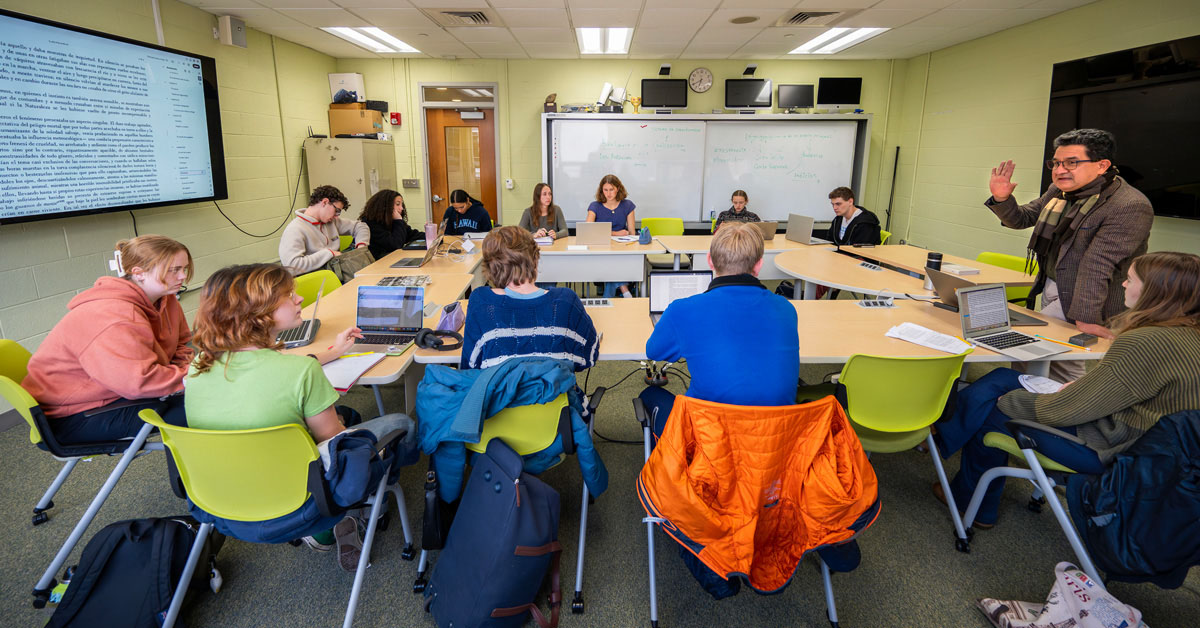 Course explores history of Orinoco River basin and connects it to contemporary issues
While exploring the history of the Orinoco River basin in “Images of Amazonia: Orinoco Narratives in Latin American Literature,” students enrolled in the course during the fall 2025 semester discovered multi-leveled layers of learning.
Taught in Spanish, the dense texts provided students with a window into the environmentally rich region and the challenges that indigenous cultures faced.
“This is not a history class,” said Domingo Ledezma, associate professor of Hispanic studies. “This is a literary class in which students learn about other cultures.” An experimental course taught for the second time, students learned about the history of the river basin in Venezuela and Colombia through literature.
Most of the hundreds of groups that spoke different languages and populated the area have largely vanished as a result of colonialism and violence, according to Ledezma, a native of the region. “The only way you can get authentic information is if you go to the primary sources,” he said.
Ledezma extended his research interests in this area by visiting the Jesuit archives last summer in Rome, where he found materials that he shared in this course.
The students analyzed how authors navigated the tension characterized in the 19th-century neo-colonial construct “civilization versus barbarism” in their depictions of the Orinoco landscape, examining how the region appears simultaneously as an earthly paradise and a threatening wilderness. The course positions the Orinoco rainforest as an active force that resists conquest and invites individuals to reconsider humanity’s relationship with the natural world.
Through their readings and research, the students discovered how humans have interacted with each other and nature for hundreds of years and connected that history with contemporary issues in Latin America.
Although deciphering the Spanish text can be cumbersome, Ledezma identified a more formidable task. “The challenge is that they are studying a world that is completely different from the one they are living in,” he said.
 “I had them transcribe a letter written by a Jesuit who was later murdered in the Orinoco,” he explained. “This is a region that was full of violence and still is today.
“In the letter, the Jesuit is describing the Orinoco, what he’s looking at and how the indigenous people are,” he explained. “The students consulted with each other to better understand what he was sharing in this document, which was like a memo intending to communicate to a superior. While they’re transcribing, they’re figuring out the language and the culture as they get immersed in it.”
Students appreciated the opportunity to enhance their Spanish skills while exploring the history of a lesser known region of the world.
“Taking this course helped me improve my knowledge and use of Spanish by improving my ability to read and understand challenging texts in the language,” said Mark Davidson ’28, who plans to pursue a major in computer science and/or global languages and cultures. “It also allowed me to participate in class discussions about difficult content.”
San Diego native Micaela Luffborough ’26 has been studying Spanish at Wheaton since her first year on campus. “The texts we read were dense and sophisticated, and we talked about them and their themes in class, which helped me improve my Spanish,” she said.
Those conversations provided the foundation for students to take on independent research projects. Each student selected a topic within the Orinoco to investigate, such as the environment, geography or indigenous people.
Rather than a traditional paper, however, the students presented their findings in an annotated digital map created with specialized software—Arc-GIS, a comprehensive geospatial platform.
Ledezma is an early adopter of a digital humanities approach to teaching and learning, and believes it is a much more effective way to learn than taking an exam or writing a paper. “Technology is just a medium for them to explore a topic for themselves,” he explained. “I believe that by completing this project, they will better remember the information, and the project can survive online or be printed and shared.”
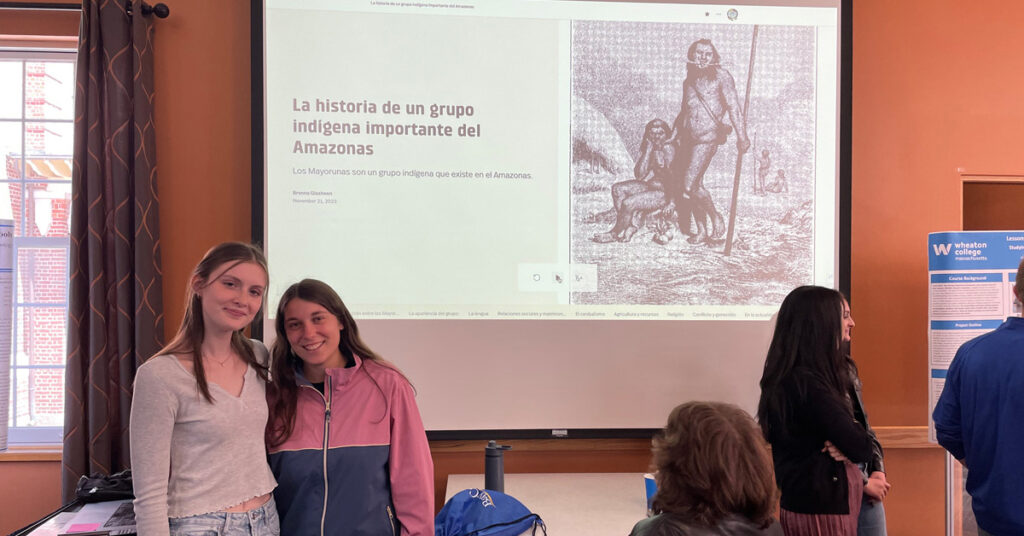
Davidson and Luffborough each selected a chapter from the novel Canaima by Romulo Gallegos, which describes life in early 20th-century Venezuela, filled with diamonds, gold, raw rubber, white foreigners and subjugated indigenous communities.
“I learned a lot from studying the main character’s journey from a civilized world to embracing the barbarism of the rainforest,” said Davidson. “The project enhanced my understanding of the power dynamics of indigenous groups and the geography of the Orinoco region.”
In the chapter she chose, Luffborough provided the historical background and context for the book and the time, as there was a “rubber boom” in South America that led to the exploitation of resources and enslaved labor of indigenous tribes. She also addressed the main themes: the balance of nature, self-transcendence, and barbarity against civilization.
The use of the technological platform enhanced their learning, the students said.
“Using modern technology, such as ArcGIS, has helped me develop and share research by allowing me to express and illustrate ideas more creatively,” said Davidson. “It has also made learning about history more engaging and enjoyable.”
Ashlyn Bisso ’24 agreed. “ArcGIS allowed us to turn the history we learned about into something we could visualize and explore,” said Bisso. She took the course when it was first offered in 2024 and is currently working in the Special Education Department at a Massachusetts charter school while pursuing an M.Ed. in special education.
“Personally, I mapped out pieces of history that just words alone couldn’t capture,” she shared. “Using ArcGIS empowered me to interact with history in a new and exciting way.”
Luffborough credits the program for accelerating her learning. “Using ArcGIS to create an informative, fact-focused website helped me better understand how to schematize digital information and presentations. It really put my learning to the test, as I had to understand and analyze the readings, and then format it into ArcGIS as an overarching theme of civilization against barbarity.”
She completed the course with a new perspective on today’s society.
“As we develop into a more technologically-advanced world, indigenous tribes are becoming less respected … Today, biological destruction and resource extraction continues to harm the environments that these indigenous tribes live in. These tribes need to be protected instead of exploited because they do not operate with as much technology as we do. It seems they operate with more love and respect for society than we do.”