Student teams win first and third in international marketing competition
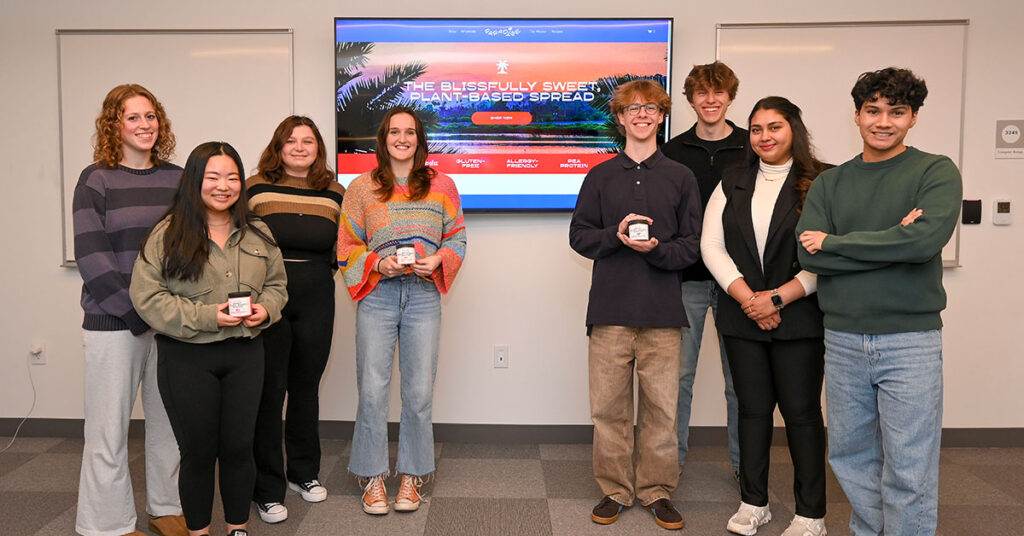
Two student teams from Wheaton earned first and third place in the international Fall 2025 Digital Marketing Competition, rising to the top of a field of 250 entries from across the United States and abroad.
The victories mark the college’s strongest showing at the event—an experiential, client-based challenge run each semester by Purdue Northwest University. A team of three students won second place in the spring 2025 event.
This fall’s competition centered on developing a digital marketing strategy for Paradise Spreads, an allergen-free, pea-protein-based food company. Students created full campaigns—from research and consumer analysis to content development, budgeting, media strategy and pitch delivery—as a major assignment for the MGMT 355 Digital Marketing course taught by C.C. Chapman, senior professor of the practice of business and management.
Professor Chapman said the teams’ victories were the result of extraordinary preparation and student drive. “Every semester on the first day of class, I always joke, ‘Hey, we’ve got to do better than last year,’” he said. “We took second last year. There’s only one option this year. So taking first and third was very cool, and I got to share the experience with the students.”
They embraced the challenge, he said. “I always grade the pitches before they get ranked in the competition,” he said. “I grade differently from the judges, of course—I’m grading on concepts, what they learned, their execution. But I knew we had a good chance. These students worked so hard. I already knew their strengths from teaching them. I thought, ‘Okay, these teams are powerhouses.’”
A high-pressure, real-world challenge
Students in the course formed teams and then spent two months developing an eight-minute pitch for the initial qualifying round. In early November, judges selected six teams as finalists—two of them from Wheaton—from a field that includes numerous large universities, such as The University of Austin at Texas and the University of Oklahoma. With feedback from the client, the finalists had two weeks to refine their strategy and deliver a 15-minute live presentation followed by a Q&A session with the company’s founder.
Chapman emphasized the authenticity and intensity of the experience. “It’s just like a real pitch,” he said. “Ten minutes of Q&A with the client sitting there asking, ‘Why did you choose this? How does this fit our brand?’”
For students, that realism made the achievement especially meaningful. “This was like the capstone project for the semester,” said Noe Garcia-Bravo ’26, a member of the first-place team. “Every week was moving up along the marketing ladder… from conception to ideation, execution. It all happened in a snap.”
The team—which also included Anvita Kurade ’26, Jp Tehomilic ’26 and Matheo Van Mierlo ’26—developed a campaign, Powered by Peas, that included the creation of a company mascot, “Peater the Pea,” to highlight the product’s unique pea-protein base. (Watch the winning presentation.)
“We decided to highlight what the product was already about, which is pea protein,” Kurade said, explaining the reason for the mascot. “So this is just an added benefit we’re trying to showcase and highlight in the product, because it’s the first ever known pea-protein spread. There’s no other one in the market.”
They also proposed that the company adopt new packaging: squeeze packets to provide school cafeterias with easy and sanitary single-serving portions. When the company’s founder asked what it would take to implement the idea, the team researched the plan to demonstrate its logistical and financial feasibility.
Garcia-Bravo, who led elements of the strategy and quantitative analysis, said his team’s focus on measurable impact set them apart. “What separates a creative campaign from a strategic campaign is being able to show how you measure results,” he said. “We had really thought about every metric we were going to use to measure our campaign, and we had a plan to use data as part of our rollout strategy to bring some of that digital storytelling to life.”
Collaboration leads to success
The third-place team—Rebecca Berman ’26, Tessa Hammond ’26, Charli McLemore ’28 and Garin Stone ’26—developed its own campaign, Paradise Made Possible, as well as a business-to-business strategy to target schools and after-school programs. For McLemore, who is pursuing a double major in marketing and design, the competition offered a first experience in large-scale digital marketing work.
“A lot of credit has to go to Professor Chapman, because he was able to break the steps of the planning process down in class, leading right up to the deadline for submitting proposals,” McLemore said. “We did a lot of the initial work in class, and we were able to delegate who did what very well based on our strengths.”
Her team also undertook significant primary research, using hometown networks to gather insights from school food service directors and youth program staff. One contact even provided a full presentation on school nutrition regulations, offering industry insights that the students incorporated into their pitch.
McLemore said that doing the work alongside juniors and seniors sharpened her skills quickly. “Specifically for me, as a sophomore in a room full of juniors and seniors, I worked at that higher level and learned from my peers,” she said. “The real hands-on experience in that environment showed me that this is exactly what I want to do in the future.”
She also noted the collaborative spirit between the two Wheaton finalist teams. “There was definitely some friendly competition, but it only pushed both of us to do better,” she said. “We both placed in the top three, which is very exciting for all of us.”
Building skills—and confidence
Chapman says the digital marketing course, which he teaches every semester, always includes participation in the competition as a way for students to develop real-world expertise. Over the course of the semester, students learn the fundamentals of marketing in a digital environment, including sales funnels, content planning, media buying and data-driven strategy.
“This will be experiential learning like you’ve never had,” he tells them early in the term. “I’m going to be teaching you while you’re doing it.”
The approach paid off. Students said they not only learned about digital marketing but also discovered new confidence in their abilities.
“I learned a lot about how to effectively work as a team… and also being confident in my own work,” said Van Mierlo. “Winning this competition helps me with that.”
Kurade echoed the idea that the team’s ability to work together and bring different skills to the project helped greatly. “I’m a business major, JP is a double major in film and marketing, Matheo is a double major in marketing and design and Noe is a double major in economics and marketing.”
The group also brings a diverse set of backgrounds and experiences. Garcia-Bravo launched a campus-based business as a first-year student; he and Tehomilic are Posse Scholars from New York City. Van Mierlo is a native of Portland, Maine. Kurade came to Wheaton from Delhi, India, and spent her junior year at the London School of Economics.
Tehomilic said the range of the team’s interests and skills reflects the breadth of Wheaton’s curriculum and of its students. “I think it kind of highlights the strengths of a liberal arts education. You get a wide variety of backgrounds and diverse perspectives,” Tehomilic said. “And when that all comes together, you really get something pretty cool.”
Kurade also praised Professor Chapman’s teaching. “He’s one of the best professors I’ve ever had. His teaching style is so interactive,” said Kurade. “It’s very interactive in the sense that he’s sharing his experiences, he’s asking about our experiences and it all comes alive in the classroom.”
For Chapman, watching the announcement of the winners with members of both teams in his office was a highlight.
“They announced third place first—and that was us,” he said. “Then they said the final decision came down to one little thing: the winning team had a mascot. And we lost it… We were screaming and yelling. It was really fun. A very cool moment to share with the students.”
But he added that regardless of the outcome the class and the competition offers the greatest reward. “The students come up with things that blow me away every year. And seeing what other schools create is fun, too. These students now have a real pitch for a real client to include in their portfolio. It’s not hypothetical. And they can say they were top three in the world.”