
Sharing his musical gift
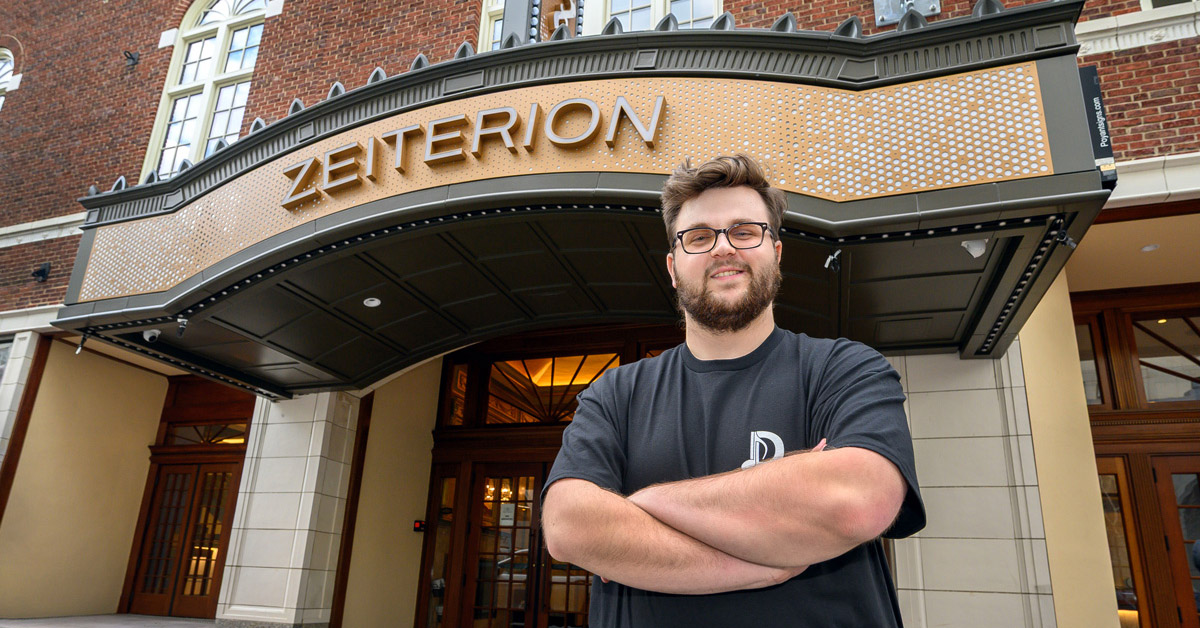
Ask Kyle Ducharme ’28 what music he likes. His answer may surprise you.
“What I write is the stuff that I listen to,” says the classical music composer. “I couldn’t tell you any of the popular people who are making music.”
A member of the Great Woods Symphony, Wheaton’s orchestra, Ducharme recently conducted the Dartmouth Public Schools String Orchestra at a sold-out Zeiterion performing arts center in New Bedford, Mass. In a concert featuring selections focused on joy, support and community, the orchestra performed a piece that Ducharme had written to honor Nikoles Joseph, who died in a car accident last June—two weeks after graduating from Dartmouth High School.
Sing Me A Story
Known as “Big Nik,” his siblings collaborated to create a narration of his life. Through the nonprofit foundation Sing Me A Story, Ducharme was asked to write a song to illustrate Nik’s story. Sing Me A Story gives children in need the opportunity to write stories, then provides the stories to songwriters who turn them into songs.
When Professor of Music Delvyn Case was contacted by Sing Me A Story, he had one person in mind to fulfill this request. “I knew Kyle could write an effective piece in a timely and professional manner,” said Case. “He’s a kind and empathetic student who embraces the opportunity to contribute artistically to his community.”
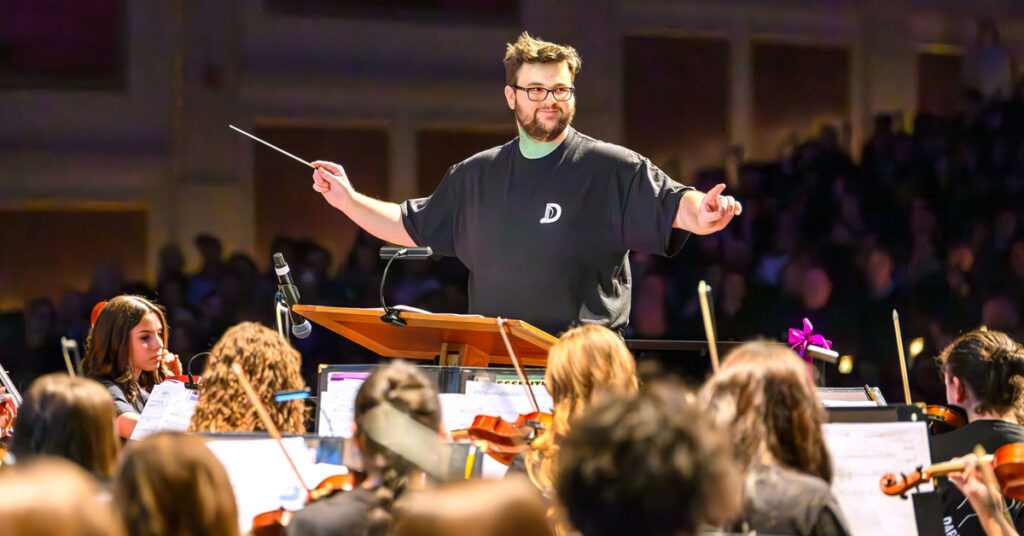
Ducharme was overwhelmed by the honor when he was first asked. “To write a piece on behalf of anyone is no small feat,” he explained. “But to do that for someone who has passed, especially when I did not know them, is a true honor. I’d like to thank everyone involved who took a chance on me.”
Titled Big Nik, the piece incorporated much of the narration, which was read by Nik’s former teachers while Ducharme conducted the orchestra. “For instance, when the narration mentioned his prom experience, where he wore royal blue, the violas responded with the “Blue Danube Waltz” by Johann Strauss. That’s how I approached it.”
Ducharme loves to direct the compositions he creates. “The most important thing for young composers is to get their music played, because otherwise, we don’t have anything,” he said. “It’s an extremely rewarding process to see a piece come together.”
The performance was a resounding success, and greatly appreciated by Nik’s family. “It was an honor to conduct on a stage with such history,” said Ducharme. “The orchestra did phenomenal, as always, and meeting Nik’s family really brought the whole project together. They loved the piece and believed that it fully captured the essence of Nik entirely. It was an experience that I’ll never forget.” Click the following link to view a recording of the performance.
Honing his craft on campus
This opportunity is one of many that Ducharme has enjoyed since arriving on campus in the fall of 2024. A Taunton native, he intended to major in history. However, after taking a few history and music theory courses and joining the orchestra, “I realized that while I still have a very strong passion for history, I wanted to be a part of the environment in the music department,” he shared.
A music major, Ducharme started playing trumpet in middle school, following in the footsteps of his grandfather. He played through high school and took private lessons, which enabled several performance opportunities, both in community and professional settings.
Ducharme started composing just four years ago and is almost completely self-taught. Today, he feels much more experienced after working with Case and others in the music department.
Case holds the A. Howard Meneely Honorary Endowed Professorship at Wheaton. He serves as music director of the Great Woods Symphony Orchestra and executive director of Deus Ex Musica, an ecumenical organization that promotes sacred music for learning, spiritual formation and interfaith dialogue.
Case has the highest of praise for Ducharme. “Kyle had written a fair amount of orchestral music before arriving on campus, and in doing so he developed a number of skills that students typically only learn in college, if not afterwards.”
In addition to composition experience, Case also lauded Ducharme’s grasp of the history of orchestral music, which he demonstrates as the Great Woods Symphony’s orchestra librarian. His responsibilities include ensuring that the orchestra members are equipped to perform the music selected. That occasionally requires transposing parts that can be more easily played on the instruments represented in Wheaton’s orchestra.
“He provides extremely valuable contributions that allow the orchestra to run smoothly,” Case said.
The art of musical composition
Ducharme draws inspiration from composers such as Ralph Vaughn Williams, Gustav Mahler and Beethoven. “I like a lot of romantic composers,” he says. “That’s where my own compositions tend to fall.”
At Wheaton, Ducharme has worked with Case to refine his technique as a composer. Through an independent study with Case, he focused on developing skills in his compositional
form work.
“It’s been really exciting to see Kyle grow as a composer,” said Case. “Even though he has a lot of experience, he has consistently sought out opportunities to learn in new ways and expand his skills.”
On May 3, Ducharme will display his talents again when he conducts a piece with the Wheaton Orchestra.
“The piece is a sonata,” he explained. “It’s written in sonata form (including an exposition, a development, and a recap). The orchestra is small (about 50 members), but mighty, and I tried to use as much of the orchestra that we have, creating solos for highly-skilled members to highlight their abilities—including the principal bassoonist and violist.”
The piece will include elements from Tchaikovsky, Vaughn Williams, Mahler and Strauss, Ducharme says. “While very much an academic exercise, I’m excited about it and looking forward to seeing how the group comes together.”
Ducharme is humbled by what he has found and learned at Wheaton.
“The people in the Music Department are just incredible,” said Ducharme. “I realize that I’m quite lucky to have a lot of the opportunities that I do. Del (Professor Case) is a mentor who fundamentally understands exactly what I’m going for when I present him with a piece of music, or a performance, and can point out things that can be improved to refine the piece. I couldn’t imagine my Wheaton experience without Del.”
Ducharme has recognized significant improvements in his music since settling in on campus. “Now, it’s much easier to display my intentions with my music,” he said. “I’m certainly not a master composer, but I have a lot more tools and knowledge to effectively tell a story through music.”