Reconsidering the historical record
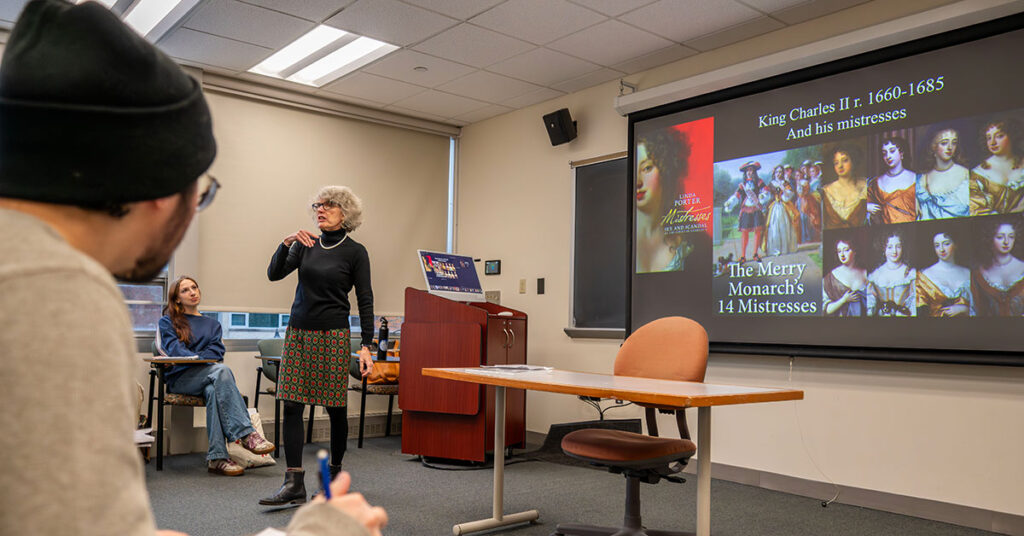
Course looks at women wielding power in medieval and early modern Europe
The portraits of the many mistresses of Britain’s King Charles II reveal as much about 17th century gender and power relations, as they do about the young women whose images are captured on canvas.
The students in Professor Wanda Henry’s classroom recently spent a fast-paced class unpacking the coded symbols of power, influence, fertility and sexuality that are contained in the paintings—shepherd’s crooks, blue robes reminiscent of the virgin Mary, flowers and cherubs.
 “Yes, yes, yes,” Henry replied to each insight and then pointed to another student waiting to offer an idea.
The conversation raced on from the King’s mistresses to Queen Anne, who presided over the unification of England and Scotland but whose 12-year reign garnered little appreciation from historians until recently. Queen Anne’s effective but disregarded rule, as well as those loaded images of mistresses of the court, offer interesting insights into the ways in which history has obscured the roles of women whether they be monarchs, mistresses or midwives.
“Queens, Witches and Whores,” the title for the course taught by Henry, a visiting assistant professor of history, examines how medieval and early modern European women gained and exercised power in a patriarchal society. The inspiration for the course comes from her own research into the Bills of Mortality, published records of the causes of death, disease and epidemics in London. Historians had assumed that midwives compiled the records. Henry discovered otherwise.
“The women who did this work were the wives of gravediggers, sextons, parish clerks—women who took on these civic roles themselves,” she explained. “Some became gravediggers. Some became sextons. And because they held these offices, they had real—if limited—authority.”
Over time, the state took the responsibility of compiling these records from local parishes and the women who began the work. The discovery illustrated how women in early modern Europe wielded power in ways both visible and obscured. And that idea fuels the heart of the course, which she has taught for the past six years.
“What we are really doing in this course is looking at how women from early medieval times to around 1800, acquired and retained power,” Henry said. The few women that historians have traditionally focused on, such as Cleopatra or Eleanor of Aquitaine, have been seen as exceptions.
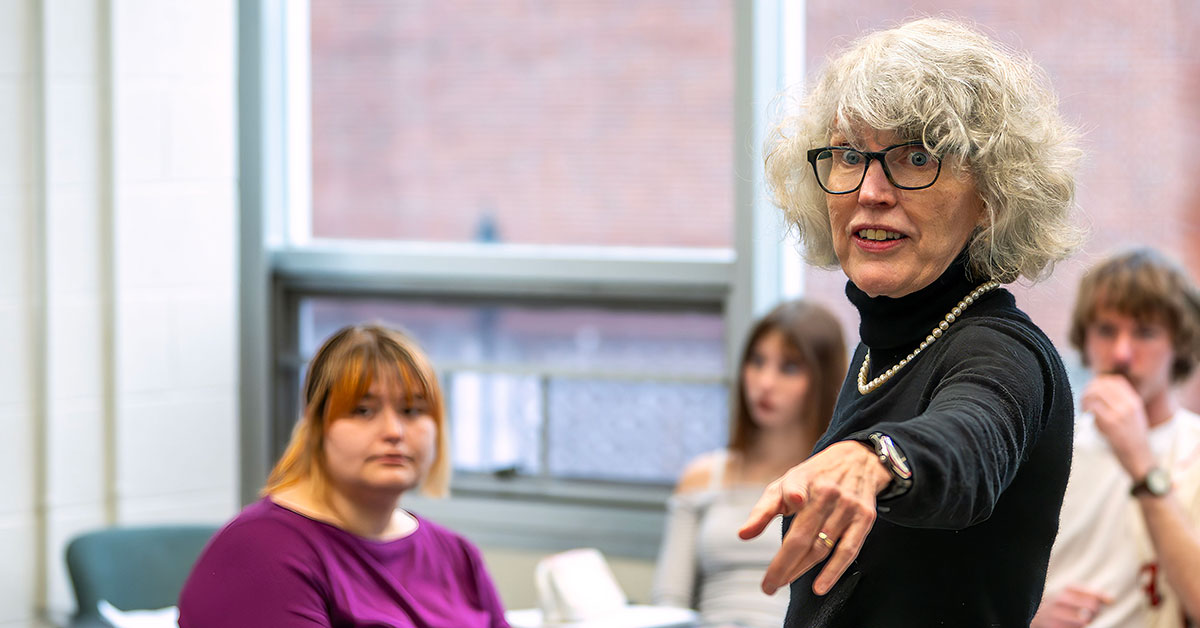 “Women having power was commonplace. Women had power in households, so this is not unusual,” she said. “We don’t know as many names of powerful women as we do of men, but that doesn’t mean that there are only those few exceptions. There were many women who had power, and they also had different strategies for getting and using it. And it’s the strategies that I’m really interested in.”
Students are interested in it, too. In fact, they are obsessed with Professor Henry’s course, one faculty member said. The proof of that lies in the fact that the course is regularly fully enrolled as well as the lively discussions that take place in her classroom.
“Professor Henry’s 300-level and more specialized history courses are very popular, so if you can get into one, it’s a win,” said Peyton Spahr ’27, a history major from Winterport, Maine, who is taking the course this semester. “I wanted to get into Queens, Witches, and Whores in my sophomore year and couldn’t, so I’m happy to be in it now.”
Spahr said the focus on the intersection of history, women and gender speaks to one of her core interests. “One theme of the class that’s significant to me is the ways that women found agency within a very patriarchal society. There are so many examples of how women exercised power—sometimes as simple as having a portrait made of themselves or using sexuality or writing as forms of agency.”
Because it is an upper-level course, students take on a good deal of responsibility for their learning. Pairs of students are assigned to lead class discussions, formulating questions and key points to guide classmates through an examination of their varied readings— 500-year-old primary-source documents and histories written from the perspective of 19th and 20th century schools of historiography to current journal articles reassessing prior accounts of the past. They write short, sharply focused response essays that encourage argumentation, evidence use, and concise analysis.
“Students run the first two thirds of the class and they ask the questions, or most of them,” Henry said. “I often can’t keep my mouth shut and I’ll ask something too, but they’re in charge.”
The result: a lively, intellectually rich space where students think historically, argue thoughtfully, and draw surprising connections between early modern Europe and the world around them.
“It is a pretty unique classroom experience when you consider the level of discussion that we have,” said Kyler Cummins ’27, who is majoring in history, English and German studies. “I always love when a class is active and everyone is contributing to the conversation.”
Cummins also noted that insights from the course are also applicable to understanding current events. “I think that’s the goal of every historian and history professor, making what you study relevant,” he said. “When you’re talking about gender history, it’s clearly something that’s going to be applicable and not just in a political sense. It’s useful to be aware of these dynamics for everyday life as well as understanding current events.”
Professor Henry seconded that idea. “Taking a history class is not just about learning what happened in the past. It’s about understanding why it’s valuable to learn about the past,” she said. “I believe that we study history to have empathy for historical actors and to realize how complicated their lives were. Understanding their strategies and their challenges gives us a better perspective on today’s challenges.”
It also gives students a way to examine gender and power in their own lives—with nuance, with critical tools, and with curiosity.
And yes, the class is fun.
“There’s no reason a rigorous history course can’t be enjoyable,” Henry said. “The next assignment involves a film about Queen Anne, The Favourite, and then we’ll be talking about spies. Students love it.”