
Measuring the environmental impact of web browsing
Kshitij Kesharwani ’28 co-creates award-winning browser extension to measure internet usage
If you are reading this article on the internet, you are almost certainly contributing to worldwide carbon dioxide pollution. But how much?
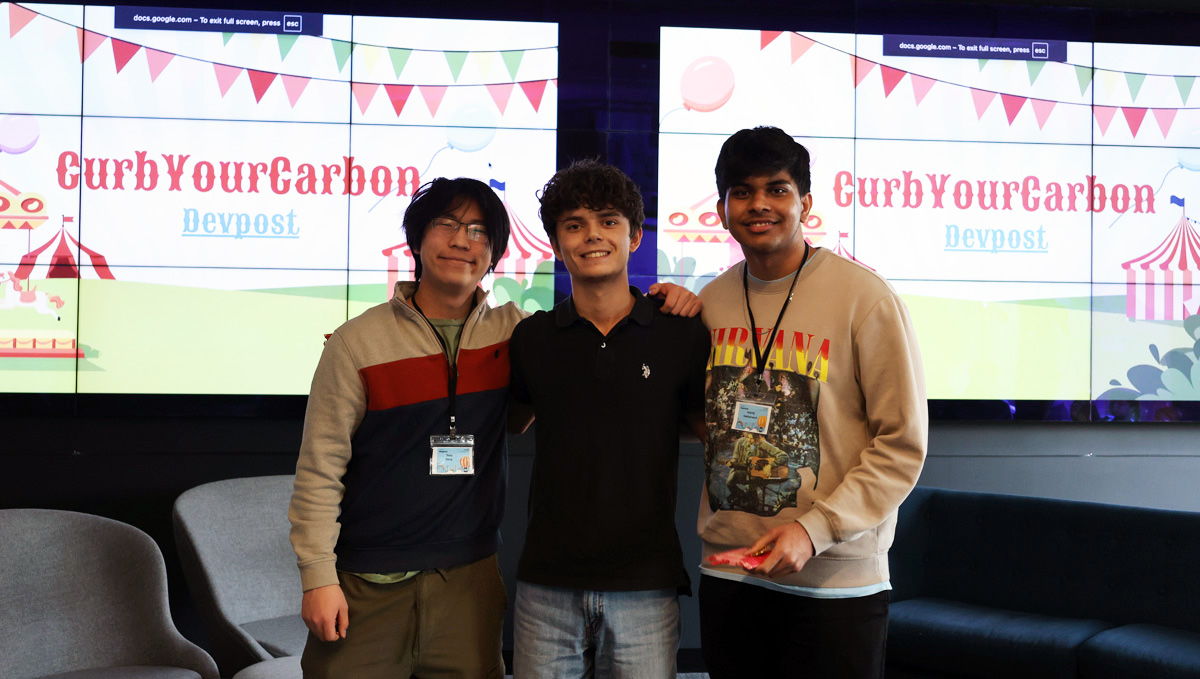
Kshitij Kesharwani ’28 worked with two newfound colleagues this winter to develop a digital tool that measures the impact of your browsing on global carbon emissions.
Their app, CurbYourCarbon, won the social impact and sustainability category at the 2026 HackBeanpot competition, held February 13–15 in Boston.
CurbYourCarbon, a Google Chrome browser extension, tracks user browsing activity, estimates energy consumption from network data transfer and device usage, and adjusts carbon calculations using real-time regional grid intensity data. The values are then converted to grams of CO2 and displayed to the user.
Kesharwani met his fellow developers, Northeastern University first-year students Raphael Bessin and Antonio Feng, during a Friday dinner at the competition. He overheard them talking about their project, introduced himself, and was invited to join their team. Less than two days later, the trio earned one of the event’s top prizes.
“When we realized that we won that category, it was literal goosebumps,” said Kesharwani. “The dopamine boost was great! We were really happy, and after the hackathon we hung out together in Boston Common for a while to talk about the accomplishment and to get to know each other.”
News about carbon emissions often cites industry or transportation statistics, but the team’s project addressed an alternative source.
“We wanted to look at carbon emissions from a different perspective,” Kesharwani said. “I’m pretty sure close to half of the 8 billion people around the world use the internet daily. People don’t realize how much carbon they are emitting.
“After developing it, we used our extension for the next few days and we could see how just our usage was affecting carbon emissions. Multiply it by billions of people using the internet every day and the numbers are insane.”
Kesharwani and his new colleagues aim to further develop the extension and eventually launch it on the Google Chrome extension store.
“We’re all busy with college, so we hope to work on it during the summer,” he said.
A native of India majoring in computer science, Kesharwani has received considerable support on campus from Professor of Computer Science Mark LeBlanc, who also serves as his academic advisor.
Last summer, Kesharwani joined the research team for the college’s Lexomics project, coordinated by LeBlanc, which harnesses the power of modern computing and statistical techniques to investigate humanities-based questions such as authorship attribution or textual lineage.
“Working on the Lexomics project gave me a much stronger understanding of how computational tools are built and tested for working with large text datasets,” Kesharwani explained, as the process taught him how to navigate complex codebases and write clearer Python code.
“I have learned a lot from Professor LeBlanc, inside and outside the class,” he said. “The experiences of working on Lexomics helped shape the way I approached developing CurbYourCarbon. While the project focuses on environmental impact rather than text analysis, the problem-solving mindset I developed during Lexomics—breaking down problems, validating results and documenting processes—carried over directly into how I structured and built the project.”
An aspiring AIML (AI and machine learning) engineer or software developer, Kesharwani currently participates in Break Through Tech, an initiative of Cornell Tech, which trains and empowers high-potential undergraduates in artificial intelligence and connects them to influential tech opportunities.
In addition, Kesharwani was recently accepted to the college’s dual degree program with Dartmouth College. He will spend next year at Dartmouth, to fulfill requirements for a bachelor of engineering degree, before finishing his senior year at Wheaton to earn a B.S. in computer science.
Kesharwani learned about the HackBeanpot from a friend at Northeastern, whom he met at Break Through Tech. Coordinated by Northeastern, HackBeanpot is one of hundreds of hackathon competitions held across the country, both virtually or in-person, where college students design and build technological solutions to solve problems.
While in high school Kesharwani worked on community service projects focused on sustainability and environment, so he was interested in the opportunity that he found by being friendly and assertive at HackBeanpot.
“I was nervous, but I decided to be upfront, and just talk to people,” he explained. “I’m glad I did. Overall, this hackathon was a good networking opportunity. I made a lot of friends, and spoke with people from other teams about their projects, and learned about their ideas and what they are studying.”
In addition, Kesharwani took advantage of the opportunity to meet representatives from Amazon, Maven AGI and WHOOP (a wearable health tracker), who served as event sponsors. “It was helpful to network with them, which may give me some leverage if I wish to pursue an internship,” he said.
Empowered by the experience, Kesharwani set his sights on his next venture and applied to attend one of the largest hardware hackathons in the nation, hosted by Purdue University in April.
“I feel like going to these hackathons will develop my creativity, help me build things and see how much of an impact I can make.”