
Listening to pain
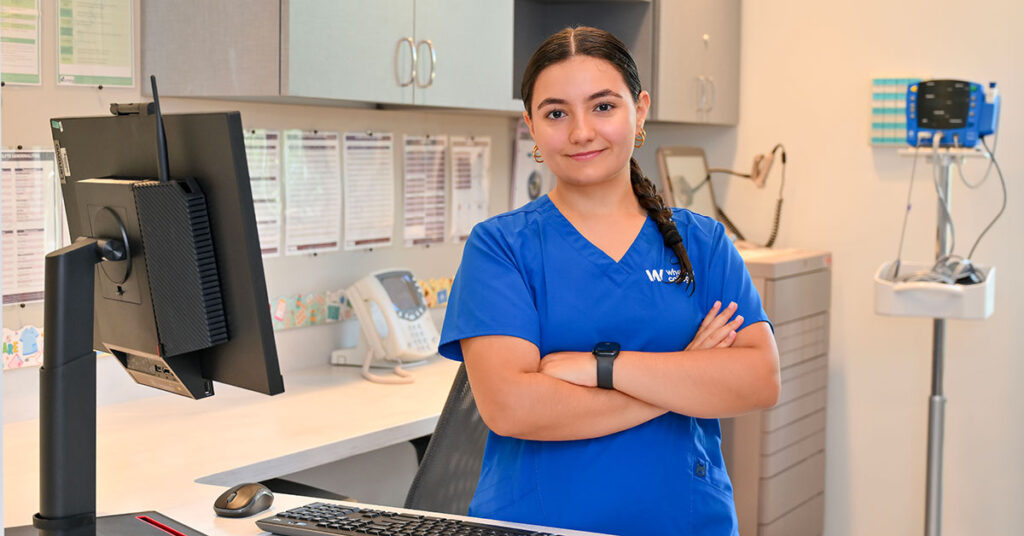
An internship at the Brown Health Pain Clinic taught nursing student Ashley Almeida the importance of believing patients, asking careful questions and adapting care to individual needs.
Ashley Almeida ’27 expected to learn about the clinical techniques used to relieve chronic pain during her internship at Brown Health Pain Clinic. And she did. She watched providers perform epidural and trigger-point injections, administer Botox for jaw pain and use radiofrequency ablation to quiet pain-causing nerves.
But some of her most important lessons came from listening to patients before those procedures began.
As Almeida conducted patient intake interviews, people told her about their experiences and challenges living with persistent pain—and about encounters with health care providers who had dismissed their symptoms or viewed them as “dramatic.”
“By contrast, they felt that the healthcare providers at the pain clinic treated their pain as real, which is not something that happens in every setting,” Almeida said.
That insight has stayed with Almeida, a senior nursing major with a concentration in medical humanities. Her internship at the Brown Health facility in Swansea, Mass., which was arranged by the nursing department at Wheaton, gave her experience with specialized procedures and patient assessment while reinforcing the kind of nurse she hopes to become: one who listens to patients closely and treats every person as an individual.
“Seeing the procedures inside the room and doing the patient intakes” were the most valuable parts of the experience, she said. “You get to know more about the patient’s life and how their pain affects them.”
Moving from observation to responsibility
The internship began with simple tasks, such as cleaning and preparing clinical areas, but soon expanded to conducting initial patient intakes. The work required her to review medication lists, identify possible risks and ask questions that would help determine whether patients could safely undergo their procedure.
Those interviews taught Almeida the importance of listening closely to patients as well as the necessity of looking beyond a patient’s initial answer. For example, the clinic’s protocol required screening patients for infections because many pain-relief procedures involve steroids, which can suppress the immune system.
“Some patients would say ‘no,’ when I asked whether they had an infection, but then you’d see an antibiotic like doxycycline listed in their chart, so you’d have to go through it with them again to make sure it was safe to go ahead with the procedure that day,” she said
The responsibility was new for Almeida. During her medical-surgical clinical rotations at hospitals in Fall River, New Bedford and Attleboro, she had worked with patients who had already been admitted. At the pain clinic, she helped gather the information needed before treatment could begin.
“We never did intakes because it wasn’t an outpatient setting like the pain clinic,” she said. “So these patient interviews were new for me, but I enjoyed it.”
Carrying the lessons forward
Almeida said her internship at the pain clinic will influence her nursing practice in several ways. For one, she saw that the same treatment does not work for every patient. Some people returned after a procedure had failed to provide sufficient relief, requiring the clinicians to consider other approaches.
“No treatment is one-size-fits-all,” she said. “These patients come in, sometimes it doesn’t work, and they have to go another route. My experience at the clinic underscored the fact that every patient is different.”
The experience also deepened her determination not to attach labels to patients—especially those seeking relief from pain that may not be outwardly visible. Individuals who suffer from chronic pain that clinicians struggle to address often report feeling that they are classified as difficult.
“I see why it’s important not to label patients, which I would never do, but after this experience, it’s an even more important takeaway for me,” she said. “And just realizing that pain is very real.”
That lesson will be particularly relevant to Almeida’s goal of working in geriatric nursing. She was drawn to nursing in part by a desire to care for her parents as they age, and she believes older adults are sometimes misunderstood within health care.
“They just have a special place in my heart,” she said.
Because many older adults live with chronic pain, Almeida knows her future work will require the same qualities she began developing at the clinic: curiosity, careful observation, flexibility and a willingness to listen.
“Chronic pain is something that these patients will deal with,” she said. “So, it’s very important to be receptive to that and show some understanding.”