
Discovering a career path in Africa
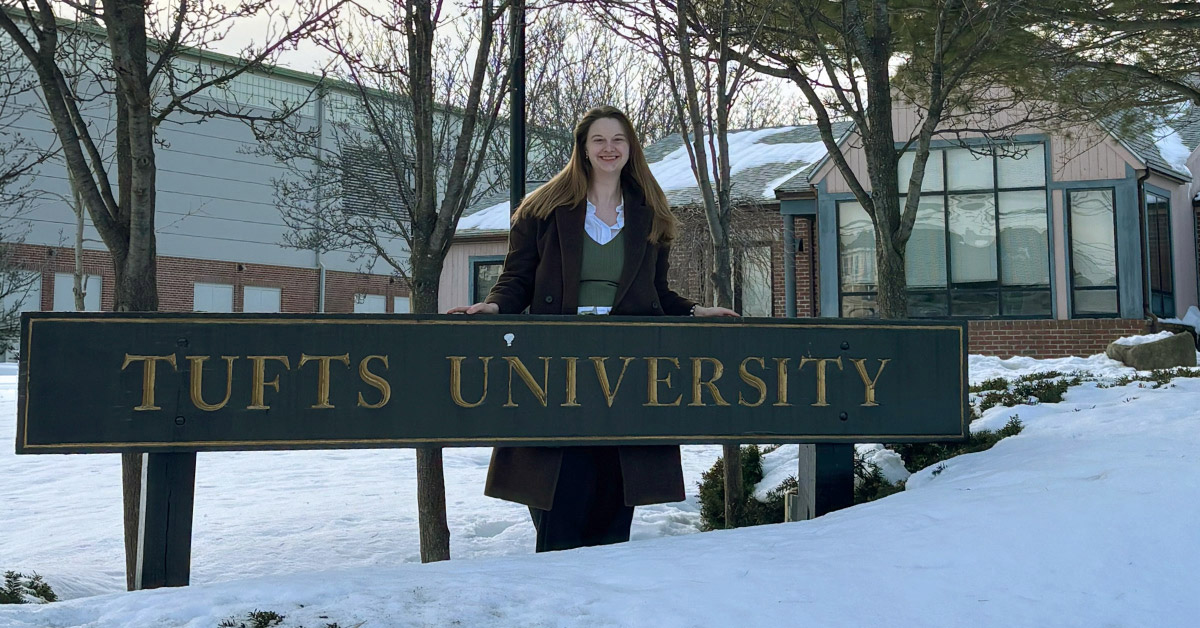
Ph.D. candidate Margy Mackin ’19 studying initiatives in majority world countries
Margy Mackin ’19 found the start of her career path during a week-long group trip to Rwanda in 2018.
She was among a dozen Wheaton students who put ideas into action during a summer youth program, as part of a semi-annual excursion hosted by President Emeritus Dennis Hanno.
“We each led a classroom, where we helped students create and implement a business idea that would address a problem in their community,” she explained, noting that it empowered them to meaningfully contribute to their communities. “Through teaching them to build skills like public speaking, collaboration and problem-solving, it sparked my interest in how youth development programs can be effective, especially in resource-limited contexts where young people often do not have access to out-of-school-time programming.”
This interest led to Mackin’s role as a research assistant and project coordinator for Special Olympics programs after graduating from Wheaton with a B.A. in psychology in 2019. “I evaluated how these initiatives were building some of the same socio-emotional competencies that we worked on in Rwanda,” she said.
Eventually, this work led Mackin to pursue a Ph.D. in Tufts University’s Eliot-Pearson Department of Child Study and Human Development. As a doctoral research assistant in the Institute for Applied Research in Youth Development, Mackin’s research centers on evaluating the efficacy of youth development programming. “I study how programs may promote thriving among young people living in majority world countries (also known as Global South/low- and middle-income countries),” she said.
“I look at how different resources within these programs, such as life skill-building activities, creating positive relationships with adults, and providing leadership opportunities, can work to help promote positive youth development,” Mackin said, indicating that the current projects in her lab are based in El Salvador, South Africa and Uganda, as well as a new project in Rwanda, which she is quite excited about.
Not lost on Mackin is how her Wheaton education and experience prepared her.
“Many aspects of my career path can be traced back to my time at Wheaton,” she said. “The Psychology Department and its faculty were instrumental in preparing me to conduct applied research in this field and develop the skills I rely on in my doctoral training.”
Mackin noted that courses such as Research Methods and Statistics for the Social Sciences provided her with a strong methodological foundation to build upon, and later serving as a student tutor for the stats course allowed a deeper dive into data analysis, which is now a part of her daily work, along with statistics.
Her Wheaton coursework also provided hands-on research experience.
“In Laboratory in Social Psychology, Professor [of Psychology Gail] Sahar guided me through designing, conducting, and writing my own research study. Also, in my internship with Dr. [Lindsay] Orchowski [affiliated instructor of psychology], I was a part of a project that worked on qualitative coding, which I also do now in my current research.”
In addition to coursework and an internship, Mackin completed a research practicum through Rhode Island Hospital, where Dr. Orchowski directs the Laboratory for Violence Prevention. There, she formulated an idea for a career path.
“I met Wheaton alumni who were research assistants and Brown University graduate students,” she said. “Having them as role models was really helpful, as I later served in similar positions.”
Mackin is thankful for the long-lasting relationships she formed at Wheaton, especially with teammates on the synchronized swimming team (now known as artistic swimming). “Being a part of that team made it easier to build friendships immediately during my first year on campus,” said the Toledo, Ohio, area native, “and I’m still friends with them today.”
For current students looking for opportunities, Mackin recommends developing relationships with professors and asking if you can assist with their research projects. “Now, as a teaching assistant, I love when students come to ask me questions, to talk about research, and seek volunteering opportunities,” she said.
Finally, Mackin suggests taking advantage of the college’s Life and Career Design Institute. Early in her career, when she was having difficulty landing a position, Mackin returned to campus and received some assistance. “Career Services helped me build my C.V. (résumé) and cover letters, and take part in mock interviews,” she said. “I wish that I had taken advantage of the services when I was a student, because they were really helpful.”
With one year left before she completes the five-year program, Mackin is considering several options, including teaching or continued research.
“I’ve been a teaching fellow here at Tufts, which I really enjoy,” she said. “I could pursue a postdoctoral degree, then a tenure-track position, but I’m also open to industry positions, such as program evaluation of nonprofits.”
Overall, Mackin’s appreciation for her Wheaton liberal arts education grows regularly, as she has realized that taking a wide variety of courses in psychology, sociology, education and economics has helped her gain traction in a multidisciplinary field. She shared, “I’m very grateful for exploring different areas of the curriculum because material from a variety of fields is the foundation of my work now.”