
Designing the future
A comprehensive approach to planning an abundant life and an evolving career
In 2015, Tyrone McClain ’04 knew it was time to leave his position as district director for Congressman Jim Himes (D-Conn.). He had considered law school, but after observing the daily work of lawyers during his time in city government in Bridgeport, Conn., he was no longer interested in that profession. And his first attempts at searching for a new position went nowhere.
“I was only applying to the jobs that I thought that I was qualified for,” he said. “I wasn’t asking myself the right questions. I was asking, ‘How do I get a new job?’ versus ‘What do I want my next chapter to be.’”
The breakthrough came when he realized that his skills and interests—helping people by forging connections and creating community—could be applied to other industries. In particular, he decided to focus on pharmaceutical companies, a heavily regulated sector where his government experience might be useful.
“I did my research. I shook my network, talked to people. I had very honest conversations, and I learned there were other people like me that had made the transition,” McClain said. “And I started looking at my value, and how I approach work and life experiences. It gave me a huge confidence boost that I could be successful in the industry.”
McClain landed at Pfizer, progressing through several positions to his current role as senior director of public affairs for inflammation and immunology. The role draws on all his skills, connecting with policy makers, health care professionals and patients and families who are struggling to live with and control chronic diseases.
“My takeaway is that you have to look at yourself and understand what your passion is and examine how realistic it is,” he said. “Sometimes what you want to do might not be feasible immediately, but knowing where you want to go can help you gain the skills and experiences that you need to get to your ultimate goal.”
Starting with vision
McClain’s story makes Sean Schofield smile. It exemplifies essential elements of the career and life planning process—self reflection on interests and values, prototyping ideas and finding new ways to apply your skills—that the leader of the college’s Life and Career Design Institute wants students to learn and put into practice during their four years at Wheaton.

program.
“I think that many people discover the principles and strategies of life and career design in an ad hoc way,” said Schofield, assistant vice president for Life and Career Design. “What we want to do is to formalize, systematize and then democratize this kind of thinking for undergraduates so they can apply it early in their careers and even before they graduate.”
Wheaton’s Life and Career Design Institute (LCDI) was launched in the summer of 2024, but the seeds for the new initiative were planted by President Michaele Whelan during her first year at the college. She appointed a task force of faculty, staff and trustees to develop bold and detailed recommendations for building upon the institution’s historic emphasis on experiential learning. The goal: create a holistic, integrated plan that extends from matriculation through graduation.
The resulting proposal called for transforming career services into a comprehensive center that helps students focus “on designing their Wheaton experience, including experiential learning, and designing their post-Wheaton life and career.” The LCDI opened in fall 2024, taking on responsibilities for the work formerly performed by career services, plus adding a variety of new offerings.
Philanthropic contributions fueled the opening of the institute. Alumni, parents and friends of the college contributed $3 million in initial funding to support the hiring of institute staff and fund expanded programming. Wheaton plans to establish an endowed fund to support the LCDI’s operations for the future.
The broad scope of the institute’s mission— helping students plan for their lives as well as their careers—reflects Wheaton’s holistic orientation. In keeping with that philosophy, the Life and Career Design Institute offers its services to alumni as well as collaborating with them to create a robust Wheaton network for the entire college community. In addition, the institute intends to develop programs for other companies, organizations and working professionals.
The designing life
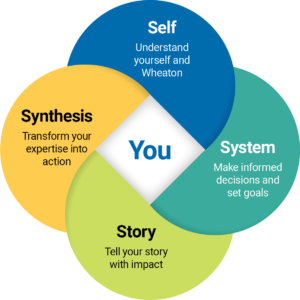 As its name suggests, LCDI’s approach to assisting students and alumni in thinking about their futures employs the principles of design thinking. This methodology emerged in the 1950s—primarily in architecture, engineering and product development—as a means for solving complex problems, explained Tania Schlatter, professor of the practice of design and the coordinator of Wheaton’s design program. The concept of applying design thinking to life and career planning was pioneered by two Stanford University professors. They developed the methodology for a class and later shared it with a broader audience in the book, Designing Your Life.
“The idea of the iterative process, that’s really the most important thing: understand what your situation is now and make decisions based on that, while having some awareness of your larger goals,” Schlatter said. “The objective is to introduce that kind of flexibility and open-minded thinking that is part of resilience. It sets up the ability to pivot when something doesn’t work out, iterate and just be more flexible.”
“When I read about design thinking for career planning, my first reaction was, ‘I’ve actually been following this approach for 15 years.’ I never used the words ‘prototype’ or ‘ideation,’ but this is the mindset that we want students to learn,’” Schofield said. “Design thinking provides a language for the process that is very helpful.”
Know your story
Lesley Bannatyne ’75 could testify to the importance of being open to new possibilities.
When she graduated from Wheaton, Bannatyne took a job as a copywriter at a New York advertising firm, but had her sights set on a career in the theatre. Over the years, she worked as a writer in advertising, public relations, publishing and journalism. It was creative work, but she saw it as a means to an end: funding her pursuit of a life in the theatre. She founded two different theatre companies in Boston.
When the opportunity arose to write a book about Halloween traditions (thanks to a tip from her first-year Wheaton roommate Margaret “Meg” Ruley ’75, a literary agent at the Jane Rotrosen Agency), Bannatyne seized it. Halloween. An American Holiday, An American History was the first of four more books about Halloween, making her a nationally recognized expert on the holiday’s history and cultural impact.
A fiction-writing class at the Harvard Extension School sparked a new pursuit: writing and publishing short stories. The professor encouraged every student to submit one of their stories to a contest; Bannatyne’s story “Gravity” won first place from the journal, bosque. More short stories, including the unforgettably named “A Corpse Walks Into A Bar,” followed, as did awards and journal publications.
“I only began to think of myself as a writer after my first book of short stories, Unaccustomed to Grace, was published,” she said, of the collection published in 2022. “Before then, I would always answer the question of ‘What do you do,’ by saying ‘I’m an actor, I write for newspapers, I work at Harvard.’”
Her second collection of short stories, Lake Song. A Novel in Stories, the recipient of the Grace Paley Prize for short fiction, hit store shelves in September.
“In retrospect, one of the things that I enjoyed about being in the theater was creating and telling stories, and my drive was always to be doing something creative,” she said. “That overarching theme of being a creative storyteller runs through all the different things that I’ve done through the years, although my specific goals changed over time.”
Starting early
Wheaton plans to integrate life and career design throughout the student experience, which Provost Jonathan Millen says is crucial. “It’s more often the case that a student finds that office when they need an internship, or when they need a letter of recommendation, or if they’re looking for employment,” he said. “By doing it from the start and continuing throughout their college career, what we’re really instilling is both the value of a traditional liberal arts education with true career readiness and preparedness.”
The traditional offerings of Wheaton’s career services center remain vital parts of LCDI: coaching students on how to write résumés and cover letters, prepare for interviews, research job and internship opportunities and develop a network of connections. Karen Single, one of the institute’s career navigators, said the need for help in résumé writing starts many of the one-on-one counseling sessions she has with students.
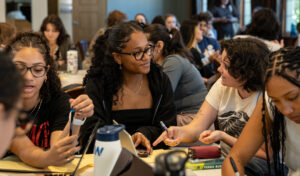
“For me, the résumé is a stepping-off point for so many other things. I use the opportunity to ask them to think about their decision-making skills, interpersonal skills and time management,” Single said. “We work on the résumé, but I’m introducing other topics and issues that they might need to consider for the next step.”
Still, Wheaton faculty and administrators don’t intend to leave it to students to find their way to LCDI when they need a résumé or funding for an internship. They are building life and career design experiences directly into every student’s experience. Starting this fall, for example, all newly enrolled students are taking a semester-long life and career design workshop that runs in tandem with the first-year experience courses (previously known as first-year seminars). The workshops meet in person every other week, with assignments to complete during the intervening weeks.
The goal is to introduce students to applying design thinking to their lives from the start of their time at Wheaton. “It’s not at all likely that a first semester, first-year student can really, truly visualize what they’ll be doing in the spring semester of their junior year nor should they,” said Kathleen Potter, director of life and career navigation. “As they move through college, they will gather new information and insights, and they will be growing and changing. It becomes part of their educational experience.”
A small group of transfer students who joined the college in January were the first to take the workshop during the spring 2025 semester. Jonathan Hacsi, who was part of that inaugural group, gave it high marks.
“The workshop makes the planning process more tangible and achievable,” he said. “Rather than one really big goal, like getting an internship, you break it down into a lot of simpler, quicker steps. It makes it much more grounded, and it gives you lots of opportunities to check things off your list.” LCDI team members brought workshop sessions to a variety of other classes and campus groups as well. Professor of Philosophy Jonathan Partridge experienced the impact such conversations can have. He invited Potter to his course, The Good Life, for an interactive session in which everyone, professor included, mapped out three different futures for themselves.
“My students got a lot out of the experience and for me, it was tremendous, too,” Partridge said. “The exercise of imagining three different future plans, rather than simply one favorite future, immediately changes your mindset to imagining multiple possibilities for what living a good life could mean for you.”
Looking beyond campus
For all the focus on engaging students in planning, the institute and the college as a whole is looking outward as well, cultivating relationships beyond campus to facilitate internships and employment. Early results showed in last spring’s Career Fair, which brought more than 70 corporations, government agencies and non-profit organizations to campus to meet with students.

The college’s guarantee of funding support for internships continues, but with a major improvement voted in by Wheaton’s faculty: a standardized approach for allowing students to earn college credit for internship experiences. A 300-level course that focuses on professional development objectives will be part of the offering.
The institute also organized an inaugural externship program, allowing students to learn more about the realities of work life in a variety of industries. “We designed the program around specific learning objectives such as gaining a strong understanding of the host’s workspace, awareness of the tasks that are part of the host’s jobs and learning what other opportunities existed in that industry or company,” Schofield said. Based on the post-externship surveys, the program will be expanding this year under the title “Career Close-up.”
At the same time, the institute has partnered with Wheaton’s Office of Alumni Relations to support and expand the college’s alumni network. Those connections are intended to be reciprocal, Schofield said.
“The idea of a linear career, where you progress in one occupation or industry, that’s not really the experience that most people have in their lives anymore,” he said. “As students and alumni transition throughout their career, I hope they will remember their alma mater and think ‘Wheaton could help me.’”
Some graduates already are reaching out. Schofield said that the institute measured a 25 percent increase in requests for assistance from alumni during the 2024–25 academic year, as compared with inquiries in prior years. While recent graduates accounted for many of those sessions, Schofield said the institute hopes to hear from alumni at every stage of their life and career. Ultimately, he said, broad engagement from Wheaton alums will strengthen the network for students and graduates alike.
“Alumni are our best employers, our best internship hosts and our best communication points for our students in networking,” he said. “They share something with the students that can’t be bought or changed: they share the experience of living and learning at Wheaton College.”