
Between hope and despair
Celebrating the legacy of Dr. Martin Luther King, Jr.
Education offers a pathway to liberation for all members of society, if educators and the educated actively treat it as a public rather than private good.
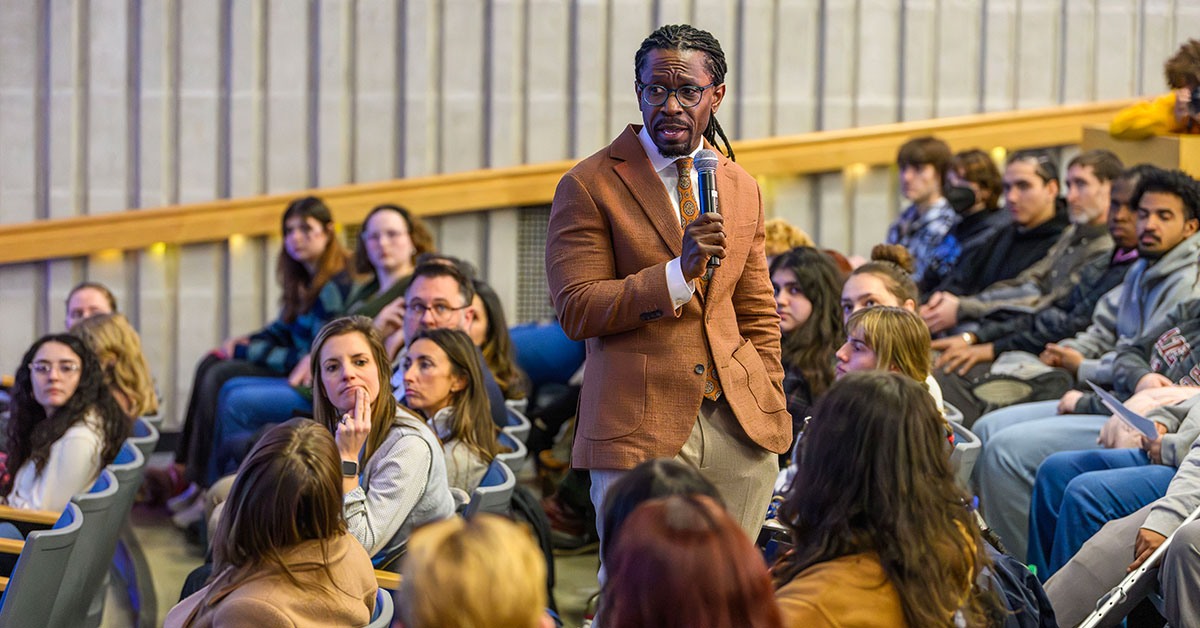
“If education is just for you, what good is it? If we don’t marshal it to transform other people’s lives, we undermine the capacity, the power, of education,” said Derron O. Wallace ’07, delivering the keynote address at Wheaton’s 2026 MLK Legacy Celebration held in Hindle Auditorium on Tuesday, Feb. 10.
The award-winning sociologist, educational policy analyst and associate professor of education policy and Africana studies at Brown University called on the audience of students, faculty and staff to make a commitment to apply their learning toward achieving a just and equitable society for all individuals.
“We are a community, and if, in fact, we are paying attention to the life, leadership and legacy of Dr. Martin Luther King, it isn’t simply to commemorate his words. It is to invite ourselves to participate in action.”
To drive home the point, Wallace asked the audience to stand and face someone they did not know and share how they would act differently tomorrow in using their education and power to empower others. For a few moments, the lecture transformed into a participatory exercise in building community as students, staff and faculty shared ideas.
Engaged Community
The pause for conversation underscored the community focus of the event, which also includes a showcase of student creativity in reflecting on the legacy of the Rev. Dr. Martin Luther King, Jr., and awards honoring faculty, staff and students whose contributions to the college further the civil rights leader’s vision and commitment.
In opening the event, President Michaele Whelan said, “This is a time for moral courage, a time to use education to become advocates for justice, with the understanding that care and affirmation are the foundations upon which we build community at Wheaton and in the world.”
The creativity showcase featured a range of works, from poems and essays to musical compositions. Ari Renzi Suprenant ’27 won first place for her poem “Hell and All Its Friends,” Alba Medina ’26 won second place for the oil pastel portrait “Pelo Malo,” and Camille Munoz ’27 placed third for her poem “The Children.” Khushi Parikh ’26 received an honorable mention for the essay “Injustice Anywhere,” inspired by Martin Luther King Jr.’s “Letter from Birmingham Jail.”
Luis F. Paredes, associate vice president for Institutional Equity and Belonging, presented this year’s MLK Legacy Awards. The 2026 recipients were Professor of Education Sarah Donaldson; dining services staff member Sean Jeanton, and Maya Stankiewicz ’26, who is majoring in women and gender studies and serves as president of Students United to Serve.
Wallace’s research, teaching and public advocacy focus on the dynamics of, and the solutions to, racial, ethnic and educational inequality, nationally and internationally. He is the author of the widely celebrated book, The Culture Trap: Ethnic Expectations and Unequal Schooling for Black Youth (Oxford University Press).
A Posse Scholar at Wheaton, Wallace double majored in sociology and an independent major in African diaspora studies, and he received a Projects for Peace grant, a Watson Fellowship, and Fulbright and Marshall scholarships. He holds a master’s degree in international education and a Ph.D. in the sociology of education from the University of Cambridge.
Understanding the Legacy
In opening the keynote address, Wallace credited his academic success to the “heritage of love” of his parents who instilled in him a respect for the “purpose, promise and power of education.” He also paid tribute to a number of Wheaton faculty and staff, including economics professors Russell Williams and Brenda Wyss, sociology professor Michelle Harris (now at the University of Albany), the late economics professor and former provost Gordy Weil, and Raquel Ramos, dean of the Marshall Center.
Reflecting on the legacy of Dr. King, Wallace noted that much of the slain civil rights leader’s legacy has been lost to the general public, which is familiar with his most famous phrases but knows little about his multifaceted advocacy. King campaigned for labor rights and protested against poverty and war as well as for civil rights.
“I stand here to celebrate his leadership, labor and legacy, flaws and all,” Wallace said. “I stand here not to render you a false hope, or deliver you a diet of despair. I ask us, just as he did in his words and works, to sit between hope and despair, to wrestle between pessimism and privatism, between dreaming and living.”
He also took aim at “triumphant tales” of the civil rights movement that focus solely on male leaders. He credited the often-invisible labor of Black women—such as Coretta Scott King, Mahalia Jackson and Dorothy Height—and queer activists like Pauli Murray, noting that without their collaboration, King would not have been “granted the ease in public and private life to advocate for racial justice in the ways that he did.”
While urging his listeners to commit themselves to continuing that work, Wallace acknowledged that it was neither easy nor comfortable.
“We know the story of Rosa Parks, and we speak of her mighty power, her effort to sit on that bus … and to take a stand,” he said. “But do you know that she was chased out of town, forced to move from her community, and she lived in Detroit in near abject poverty with her husband for the rest of her life?”
In closing he quoted the words of Toni Morrison, “When you get these jobs that you have been so brilliantly trained for, just remember that your real job is that if you are free, you need to free somebody else. If you have some power, you need to empower somebody else.”