
A course that changed a classroom
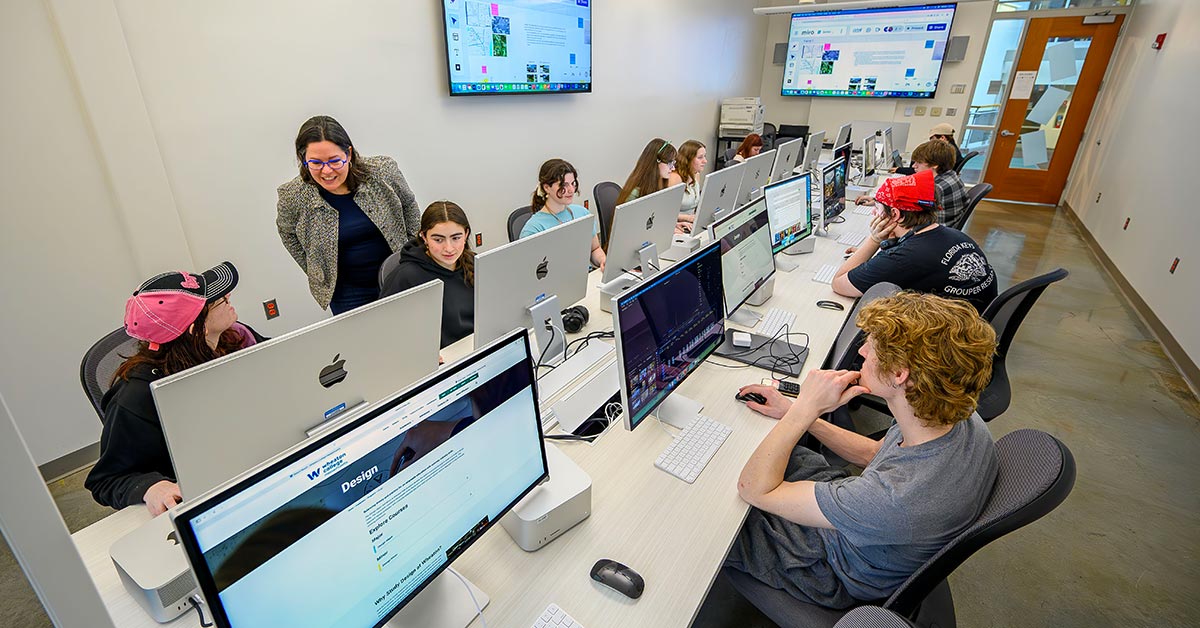
The graphic design lab in the Mars Arts and Humanities got a makeover to optimize the space for the way students use it now.
The architects of the renovation: a team of Wheaton students who approached the project like a professional design firm would: interviewing users, studying how people used the space and developing competing concepts.
In January, their ideas took shape in Mars Arts 223—an outcome that transformed both the physical space and the educational experience of the students who designed it.
The project emerged from Design Studio: Introduction to Professional Practice, a course taught by Program Lead and Professor of the Practice of Design Tania Schlatter that simulates the practices of a professional design agency. Students work on multiple projects for campus clients, tracking their time, collaborating in teams and presenting design concepts as they would in a real studio.
“The course simulates, as much as possible, a professional design studio experience,” Schlatter said. “Students are working on teams, managing projects and interacting with clients while applying the design skills they’ve learned in earlier classes.”
A real problem to solve
The classroom redesign began when Associate Professor of Film and New Media Patrick Johnson approached Schlatter about a long-standing challenge.
The lab—built in the late 1990s—had grown increasingly difficult to use for contemporary classes.
“It hadn’t really been upgraded since it was built,” Johnson said. “The old setup had these carrels that faced the wall. It made it hard to use the space for discussion or group work.”
Johnson also hoped to expand the classroom’s capacity to meet student demand in the arts and film courses that use on the space. “We needed to reconceive the space to get up to a minimum of 16 students,” he said.
For students in Schlatter’s course, Johnson became their client. They interviewed him as well as other professors and students who used the space, documented how people worked in the room and began experimenting with new layouts that could support lectures, individual design and editing work and group critiques and discussion.
Designing for users
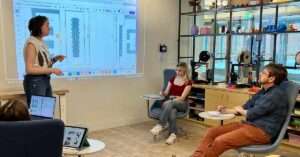
Among the students tackling the challenge was Lina McCretton ’24, now a UX/UI designer at Brightstar Lottery. At the time, she approached the project the way designers often do: by first understanding how people used the room.
“I interviewed Professor Johnson and asked, ‘Okay, I’ve never taken a film class. Tell me how you are using it,’” McCretton recalled.
Johnson explained that editing often requires quiet, individual focus—but his classes also needed room for discussion and film screenings.
The existing layout worked poorly for both.
“It was a very long, skinny room,” McCretton said. “When they tried to do screenings or have a discussion, it was just an awkward space to navigate.”
Her proposal drew inspiration from an unexpected place: a café.
“I used inspiration from the typical Starbucks layout where they have that one massive long table and people sit together but still do their own thing,” she said.
The concept centered on a long shared table running down the middle of the room. Students could work individually at laptops while still facing each other, allowing the space to shift easily between collaborative and independent work.
“The idea of having that one central point for people to come together and chat, while also being able to do their individual work, was kind of the goal,” McCretton said.
Learning through iteration
The renovation project also became an exercise in professional design collaboration.
Students produced multiple concepts, experimented with scaled layouts and shared tools for visualizing furniture placement and circulation.
One student on the team, Pear Wongwatanawisut ’25, created a standardized system of symbols to represent desks and chairs, allowing teams to quickly iterate on designs together—an approach Schlatter said transformed the group’s workflow. The team also learned how to create renderings of room designs using special software from fellow student Ahaan Singhania ’25, who founded Mumbai-based design practice CoveCraft Studios after graduation.
Projects like this reflect the course’s broader goal: helping students move from theoretical design knowledge to real-world problem solving.
Schlatter intentionally runs several projects simultaneously so students experience the pace and complexity of professional creative work. Other projects that students in the course tackled included the design and production of signs and user manuals to assist student proctors who work in the college’s Fab Lab and the creation of a logo for the Beard & Weil Galleries.
“The class models a real design studio environment—this hive of activity where some people are working on one thing and others on another,” she said.
“It’s collaborative. They’re all working in teams—nobody works solo,” she said. “Part of the course is about establishing norms for working together: What kind of community do we want to be? How do we interact? What do we do when there’s conflict? How do we express opinions constructively? What happens when we’re behind on a deliverable, and how do we handle that?”
From ideas to reality
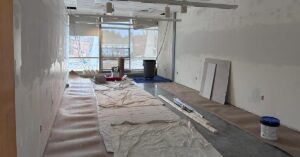
In the end, the classroom redesign transformed from student proposal to completed reality.
Facilities, Information Technology and Media Services staff completed the renovation over the 2025–2026 winter break in what Johnson described as a rapid and highly collaborative effort that was organized by Professor of Art Kelly Goff, who serves as chair of the Department of Creative Arts.
“The project was on a really tight timeline,” he said. “Facilities, IT and Media Services made a herculean effort to get it all done.”
The new configuration replaced the wall-facing workstations with a layout designed for flexibility and collaboration. Today the space supports classes in photography, design and film production.
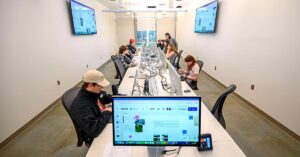
Just as important, the redesign allowed the department to increase enrollment across those courses.
“We’re able to raise the enrollment cap for all the classes using the room,” Johnson said.
For McCretton, learning that the central-table concept had been implemented after she graduated was both surprising and gratifying.
“That’s amazing,” she said. “I’m happy to hear it panned out.”
As a double major in design and English literature, McCretton said she appreciates the broad range of skills and experiences she had as an undergraduate.
“I’m so happy that I studied the liberal arts at Wheaton because I have a background in English, marketing and other subjects that really helps me every day in my job as a designer,” she said. “I work on designs for apps, but a big part of that involves research into why people think the way that they think. So, there’s a lot of analysis, research and writing involved and my English literature skills help with that a great deal.”