
Behind the rules of the game
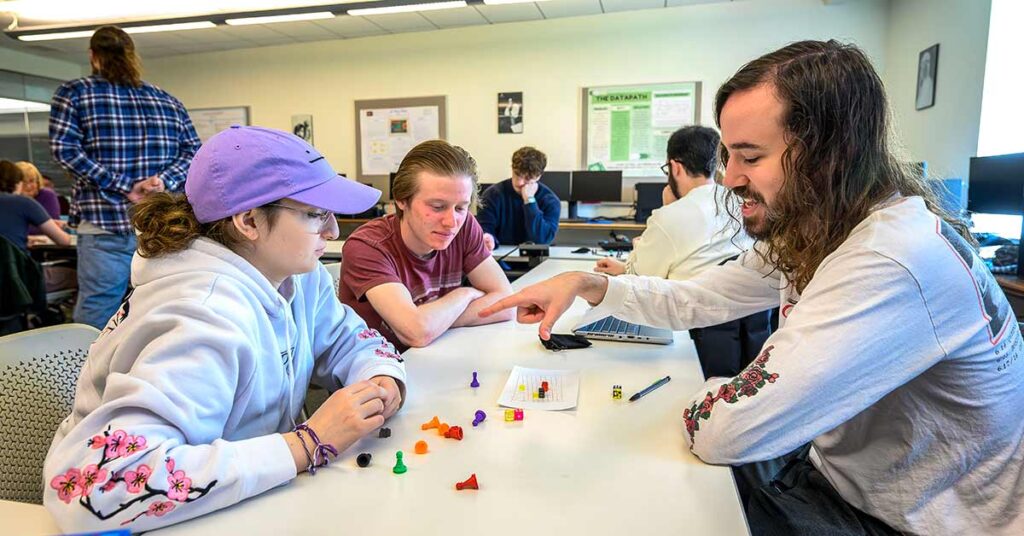
In the computer science course Game Development, students learn about the principles of game design as well as how to create 2D and 3D digital games with Godot, an object-oriented programming language.

Small groups of students were deep into planning the rules of a new board game using a grab bag of dice, chess pawns and other game pieces each team had been given when Professor Nicholas Almeder interrupted their work to introduce a new rule for their in-class assignment.
“I’ve decided that the condition for winning the game should now be the player who gets to seven points first,” he told the class, taking on the role of the creative director of a company developing a new game.
The students in CS 298: Game Development listened closely to Almeder, pausing their work for a moment to take in the new requirement, then returned to their discussions, hastily revising the rules of the games that they had been inventing over the previous 20 minutes.
Almeder planned the change to make a point, which he discussed with the students at the end of the class. “If you’ve been working on a video game for a year or two, which is common, and then you decide to change the rules, that’s going to be very difficult to do,” he said, pointing out the thousands of lines of code that would need revision. “By contrast, a board game is much easier to change on the fly so it can be a good way to start prototyping an idea.”
That moment captures the essence of the course: blending creativity, technical skill and critical thinking to help students understand not just how to build games, but how and why games work.
Developing an accessible approach to game development

For Almeder, the course grew out of both personal experience and student interest. Before teaching at Wheaton, he spent years working in software engineering roles, including quality assurance, where he found satisfaction in creatively “breaking things in unexpected ways.”
But when it came to making games himself, he found it challenging. “Even with an advanced degree in computer science and a decade of professional experience, I struggled for a long time to make games. It’s its own beast,” he said.
Having invested many hours of study into game development, Almeder designed the course to make learning the art and science more accessible. Rather than building a single large project from scratch, students develop a series of small, manageable systems—what Almeder calls “proofs of concept”—and gradually assemble them into something more complex.
The approach mirrors how professional developers work and helps students avoid burnout while building confidence. It also reflects a broader philosophy: that learning happens best through doing.
Learning by playing and building

The 20 students enrolled in the course, the maximum allowed, span a range of majors from computer science to psychology, English and design. While students must have a background in programming—specifically object-oriented concepts—the course emphasizes the interdisciplinary nature of game development.
Some of the course assignments involve playing and analyzing existing games. One week, students borrowed board games from the college’s library to analyze in-person games, including Candyland. (Students criticized the classic because it relies on chance and does not allow players to influence the outcome of the game through decision-making.)
Students also examined video and computer games from earlier eras by visiting the college’s Computer Museum, which features two emulators offering access to dozens of games. The museum’s systems allow students to experience playing games that were popular and then faded into obscurity before they were born, such as early Nintendo Gameboy offerings.
Almeder jokes that students can tell their parents that their “homework was to play video games.” But behind the play is a serious goal: helping students think critically about design choices and apply those insights to their own work.
Declan Buchanan ’28, a computer science and design double major, said the course aligns closely with his long-standing interest in games. “I’ve been interested in game development for many years,” he said.
For Buchanan, the course is not just about coding. “It’s really a lot more than coding,” he said. “We need to go over a lot of the code, but it’s probably about two-thirds technical and one-third game design theory.”
Central questions include how digital games communicate the rules of a game to players and how the mechanics of a game shape player behavior and experience.
Jonathan Vasquez ’28, a computer science major, was drawn in part by Almeder’s teaching style, but what he appreciates most is how much the course expands beyond programming. “You can’t make a game without knowing what makes games good,” he said.
Assignments might include analyzing how a classic game “explains” the rules without explicit, on-screen instructions, or designing a simple interactive system that feels intuitive and engaging.
The psychology of game play

For some students, the course offers a new lens on familiar interests. Socorra McLaughlin ’26, a psychology major completing an honors thesis on perception, sees strong connections between game design and her major course of study.
“It’s hard to enter the game dev space and not need to think about player behavior,” she said. “I think game development draws from psychology in ways that are similar to architecture and interior design. You need to think about how players will behave when they encounter a certain situation or environment. You need to consider, ‘What are they likely to do? What might they do that you didn’t intend them to do?’”
In Game Development, those ideas come to life through experimentation. Students test their creations, observe how others play them and revise accordingly—sometimes discovering that players behave in unexpected ways.
“People will do what people do,” Almeder said. “If you give them a set of rules, they’re going to find ways to enhance them, break them or bend them.”
For Vasquez, one of the most rewarding aspects is seeing code come to life. “With game development, it’s very easy to have your code, and then see output in a very tangible way,” he said.
That immediacy can be motivating, especially compared with more abstract programming assignments.
At the same time, the course challenges students to think beyond technical execution. Games are not just software—they are experiences shaped by visuals, sound, storytelling and interaction.
“It’s an amalgamation of a bunch of different art forms,” Vasquez said. “You need visuals, you need sounds, you need to consider the whole user experience. In that way, it’s similar to web design. Ultimately, you are trying to create an immersive experience.”
Skills that go beyond games
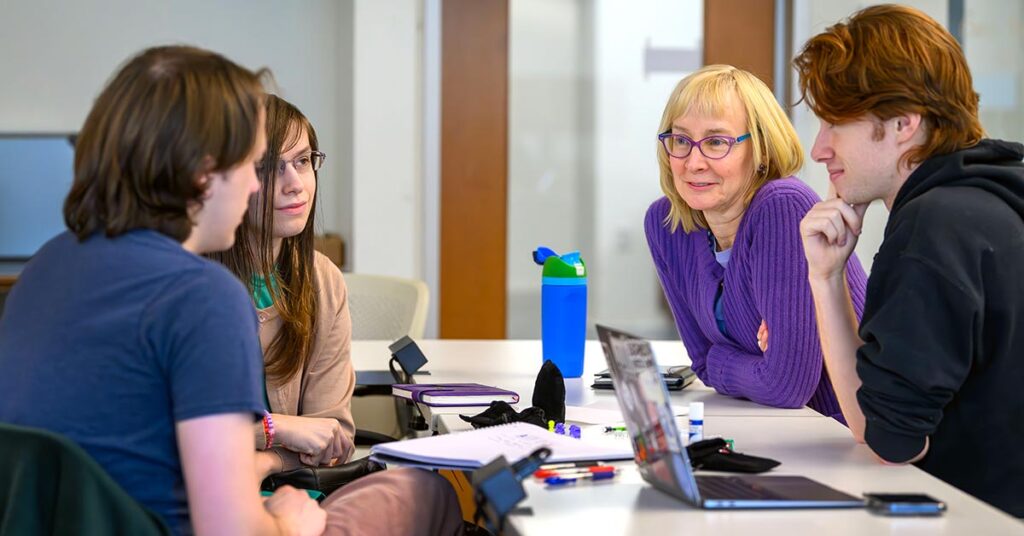
While some students hope to pursue careers in game development, the course is designed with broader applications in mind.
Buchanan said he appreciates the way the course brings together his majors in computer science and design. “I’ve always loved building things, working with my hands and designing things,” he said. “I’m very interested in learning every facet of the design process as a way to create things that address the intent or goal of the project and that are well produced. That’s what this course is about.”
Almeder emphasizes that the skills students gain—problem-solving, systems thinking and collaboration—are transferable across fields.
“I’m a firm believer that there is no wasted skill,” he said.
Students learn to break complex problems into manageable pieces, test ideas iteratively and communicate effectively with users—all essential skills in technology, design and beyond.
They also gain confidence. Through trial and error, they learn that persistence leads to progress—a lesson that applies far beyond the classroom.
Perhaps the most striking aspect of Game Development is the level of engagement it inspires. Almeder recalls students being disappointed when a snowstorm canceled class.
“I’ve never seen students so upset that they couldn’t come to class at 9:30 in the morning on a Monday.”