Transforming public spaces
Maia Hay ’20 led community mural creation during Wheaton artist residency
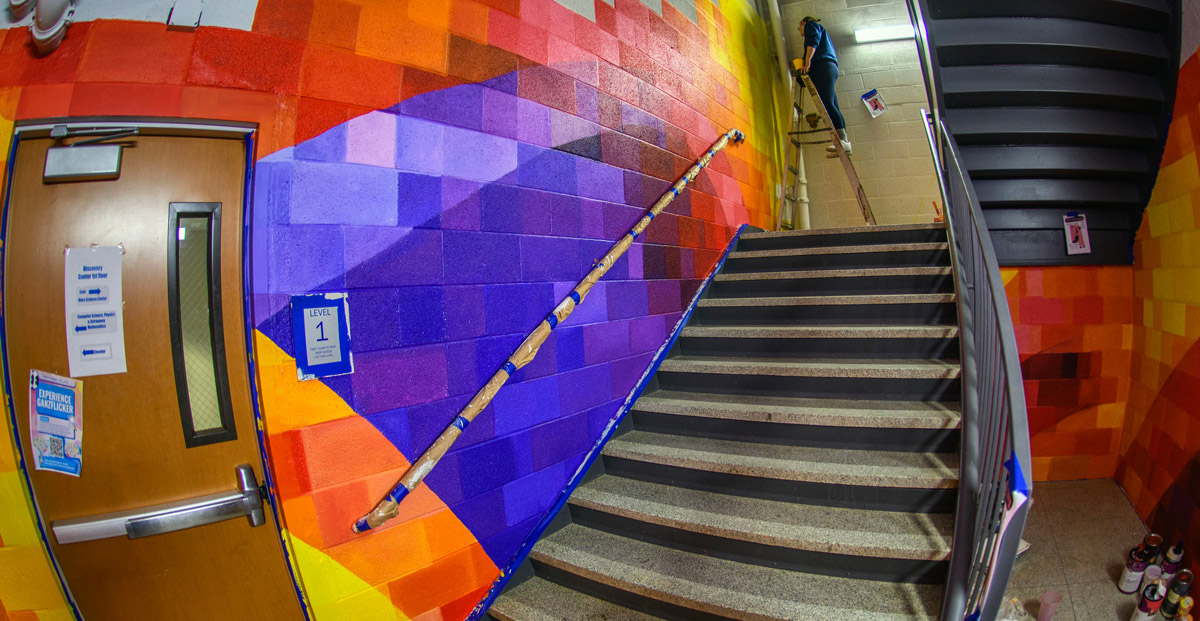
Grey concrete block walls now burst with a kaleidoscope of colors. Bold blocks of orange, yellow and red, transitioning to vibrant blue and purple.
What was once a drab staircase in the Diana Davis Spencer Discovery Center Dedicated to Free Speech and Innovation now provides visual delight.
The transformation occurred thanks to the direction and work of Maia Hay ’20, who completed a Beard & Weil Galleries Artist Residency in February. It is the second colorful public art project the former Watson Fellowship awardee has left on the Norton campus. Her “Beyond the Rain” sculpture resides in front of Gebbie Hall.
Beard and Weil Galleries Director, Elizabeth Hoy, invited Hay back to campus through the Evelyn Danzig Haas ’39 Visiting Artists Program. Aware of Hay’s experience as a mural artist, Hoy asked her to create a mural for Wheaton in a non-arts building with the goal of engaging the entire campus community.
After deciding on the Discovery Center, President Michaele Whelan suggested the staircase, and Hay worked with students and administrators to design and create the public work of art.
Knowing the location and the desire for student engagement, Hay knew it called for an abstract approach, with a graphic design focus on color manipulation.
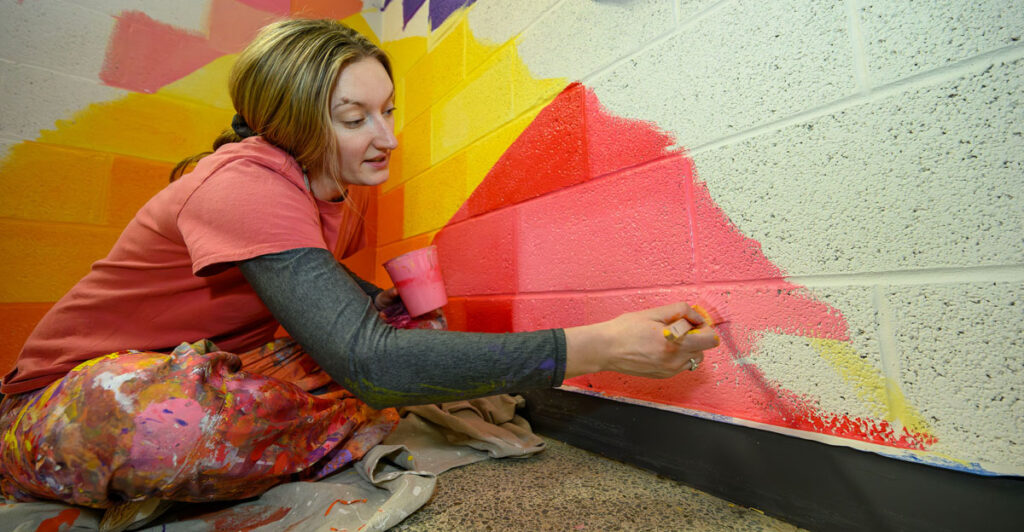
“I drafted coloring sheets for students and hosted a community workshop in the gallery for students to share ideas, what the colors could look like, what we wanted to avoid, and how to bring light into a space that desperately needs it,” Hay explained. “I put each of the workshop sheets underneath the wall photographs to figure out the final concept design.”
Students have been critical to the project from the beginning, she said. “From helping with color conception to physically painting on the wall, as the design continues to grow and take shape, each person’s contribution adds to the work.
“When I was living in Ireland, I did a similar workshop layout for the community mural done in Ballyvaughan titled ‘Ecology of the Burren.’ I think especially when public input is key to the project, having open spaces where anyone can join is critical to both the design and impact of the mural.
Hay has gained much experience since her 2020 graduation. She volunteered at City Year in Boston, then studied and participated in public art projects in Canada, South Africa, France, Portugal and Serbia for her Watson Fellowship.
“The theme of my fellowship was ‘For whom, by whom; perspectives on public art,’” she explained, where she studied how communities used art to re-socialize and engage following the pandemic.
Among her travels, Hay implemented public art installations and murals with Steppes in Toronto, participated in a public art festival on Portugal’s Azores Islands, and ran sites for the Grenoble Street Art Festival in France, where she first started large-scale painting.
“During my Watson year, I experimented and realized how other muralists paint on a large scale,” she explained, realizing the intention of public art. “My philosophy is that the artistic work you create is for the community, and if they’re not enjoying it, you should change your directive.”
Hay earned a B.A. in studio art and political science from Wheaton and a M.A. in art and ecology from Ireland’s Burren College of Art. She returned to campus for a three-week artist residency to begin the spring semester, and was tasked with creating a community mural.
With a master’s degree focused on art and ecology, Hay practices what she preaches, maintaining an acre garden at home, where she grows plants, flowers and vegetables and harvests beeswax from a dozen hives to create natural paints for her work.
Since art often creates waste, Hay has committed to practicing sustainability in her art.
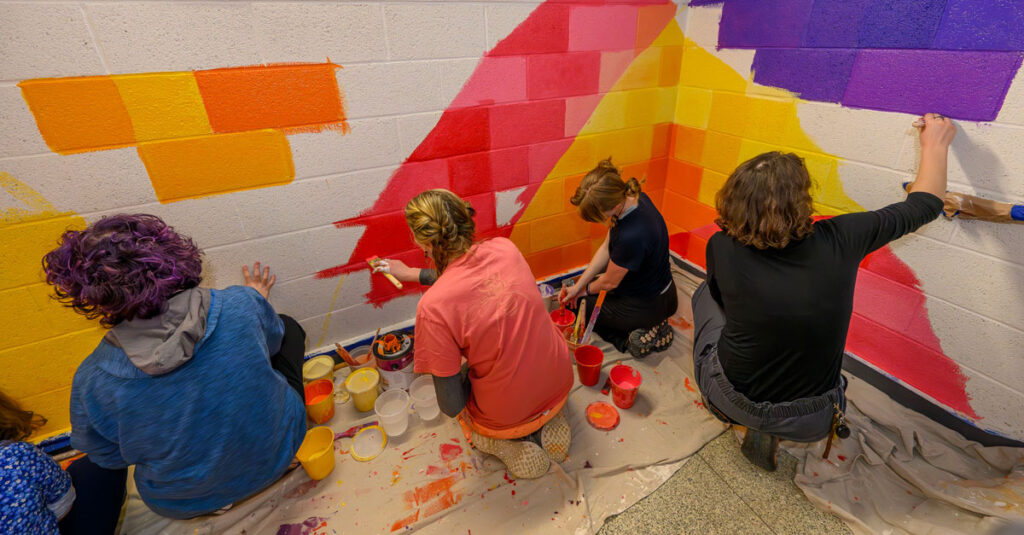
At Wheaton, Hay was gifted nearly two dozen gallons of white paint that the college was no longer using, which served as a base coat for the community mural, along with some recycled paint from a public art project she worked on in Providence.
“It’s been wonderful being back on campus, connecting with students and sharing what my five years have been like since I graduated,” said Hay, who also offered to be a resource for a Wheaton student’s Senior Seminar. “I suggested steps they can take and shared what I learned from my research.”
Hay said that many students just walked by and asked if they could help, even the non-art majors, and they enjoyed being a part of the process. “That’s a testament to Wheaton,” she said. “People just want to get involved. From the beginning, the students were absolutely wonderful.”
The design for the mural enables participation, Hay said. “I try to paint things local to the ecology that is specific to the site,” she said. “This references a sunset with color blocking and warm tones.” Once assigned an area and a color, the painters could make the color lighter or darker. “This let them engage with it and allowed the design to grow.”
Students gained much from their involvement. “While working on this project, I really enjoyed seeing Maia’s mind at work,” said Devin Kwarula ’27. “As an artist myself, it is a pleasure to see people’s ideas expressed in such a profound way. She took an abstract concept and expressed it so clearly, beautifully and colorfully.
“By working with Maia, I also learned the importance of persevering through hard work,” Kwarula shared. “Watching Maia work throughout the day on this project, even as I went to several classes on some days, is something I admire and deeply respect.”
Peyton Emery ’27 enjoyed the experience. “Helping paint the community mural was very relaxing and freeing,” she said. “I love how the mural livens up the space, and I’m happy that I helped create this beautiful work.”
The campus response to the work has inspired plans to continue the mural to the third floor (it currently covers the 1st to 2nd floors). Hay worked with Hoy, who secured funding and supplies to enable Hay to continue the mural’s ascension in March.
“We give the artists a gift of time and space,” said Hoy, “and they provide the gift of sharing their process. We usually see only the artist’s finished project, but it’s beneficial for students to see that sometimes things do not go as planned. I think every student who helped to paint feels a sense of ownership and belonging and being a part of this amazing art that will be there forever.”
Hay said that the project reaffirms her belief in participatory public art. She intends to keep teaching co-op classes and facilitating pop-up exhibitions toward the state’s South Shore, with a goal to help create collectives in the smaller communities.
“I’m going to keep pushing for more public art,” she said. “Something so simple can make a lasting impact.”