
Headstart for turtles
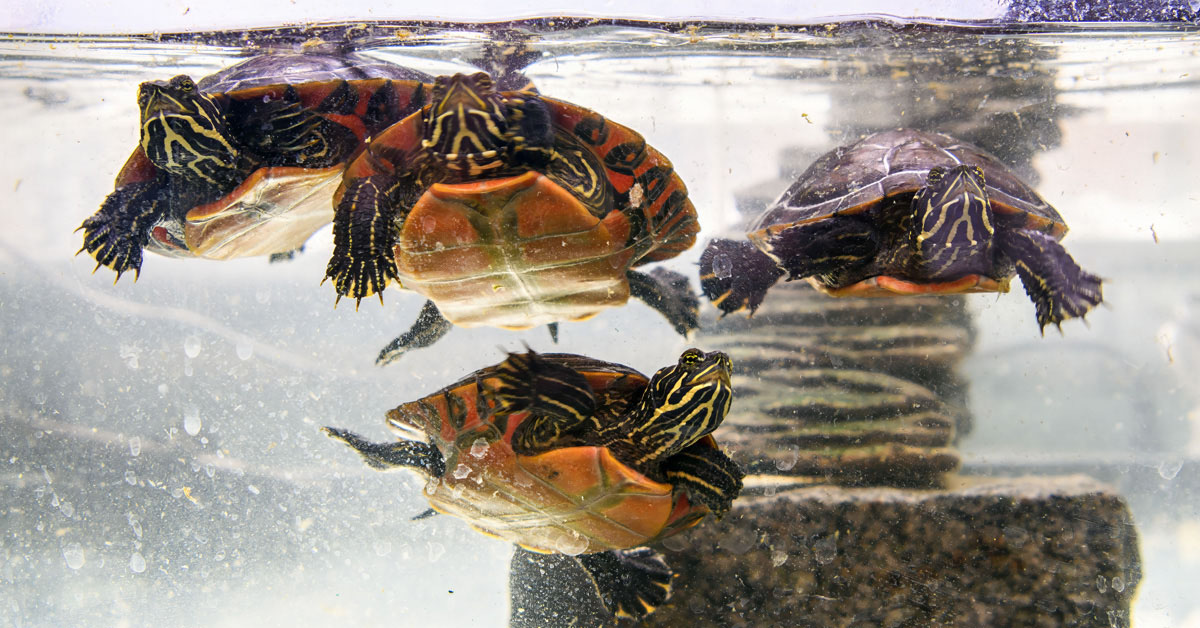
Wheaton helps repopulate endangered species of local reptile
From a hallway in the lower level of the Mars Center for Science and Technology, you can see them, playfully swimming and eating. Barely larger than a quarter when they arrived in September, the Northern red-bellied cooters now stretch their necks confidently beneath warm lamps—temporary residents with an important mission.
The endangered turtles are part of a long-running conservation effort coordinated by MassWildlife’s Natural Heritage and Endangered Species Program, which for four decades has worked to restore the Northern red-bellied cooter to Massachusetts ponds. Once reduced to fewer than 300 individuals statewide, the species now numbers more than 2,000, thanks in large part to a Headstart program that raises hatchlings through their most vulnerable months.
Wheaton is in its fourth year participating in the program and is the only college among roughly 20 schools and museums across the state to do so. Supported by faculty research funds, the project is led on campus by Susan Barrett, senior professor of the practice of biology, with the daily care handled by a small team of student assistants.
“I think it’s very important that we’re contributing to the conservation of a local species,” Barrett said. “And I love that this project is visible in a public space, so anyone walking by can see what conservation work actually looks like.”
In September, participating institutions receive four newly hatched cooters, each weighing about nine grams. From fall through spring, the turtles are raised indoors before being returned to MassWildlife in May. There, they are tagged for identification and released into ponds in Plymouth or Barnstable counties, where the species is native.
Keeping the turtles healthy requires carefully recreating summer conditions indoors. Two ultraviolet lamps hover above the tank on a 14-hour light cycle, while an aquarium heater maintains water temperatures between 82 and 84 degrees Fahrenheit.
“We’re basically convincing them that it’s still summer,” Barrett explained. “That way, they keep eating and growing instead of slowing down or entering hibernation during the winter months.”
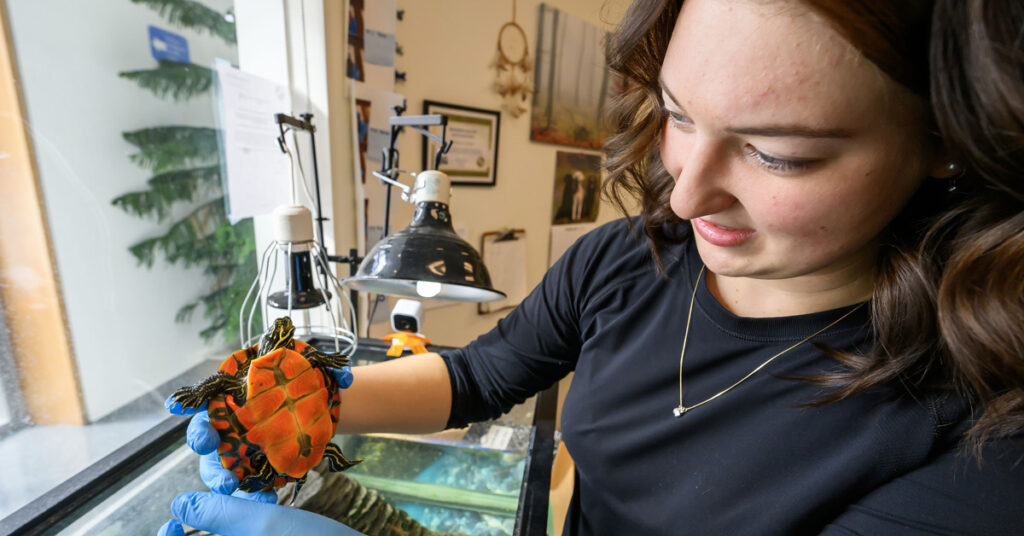
The turtles’ care routine—feeding, tank cleaning, and close health monitoring—is carried out by two to three student assistants each year. This spring, the team includes Emma Claire Lambert-Shemo ’26, a neuroscience major, along with environmental science majors Jayden Carias ’26 and Abby Williams ’27.
Lambert-Shemo, now in her third year on the project, took a marine biology course with Professor Barrett during her first year on campus. She was introduced to the turtles by Emily Edds ’23, a teammate on the swimming and diving team who had served as one of the program’s first student caretakers.
“Professor Barrett’s passion for these little critters really stuck with me,” Lambert-Shemo said. “Once I saw how hands-on the work was, I knew I wanted to be involved.”
The students check on the turtles twice a day, inspecting their general appearance and the conditions of their shells. Hatchlings are especially vulnerable to umbilical infections and shell rot, making close observation critical.
“The turtles are weighed and measured weekly, to monitor for any failure to thrive,” Barrett said. “A lack of weight gain for two consecutive weeks triggers appropriate measures to help get it back on track.”
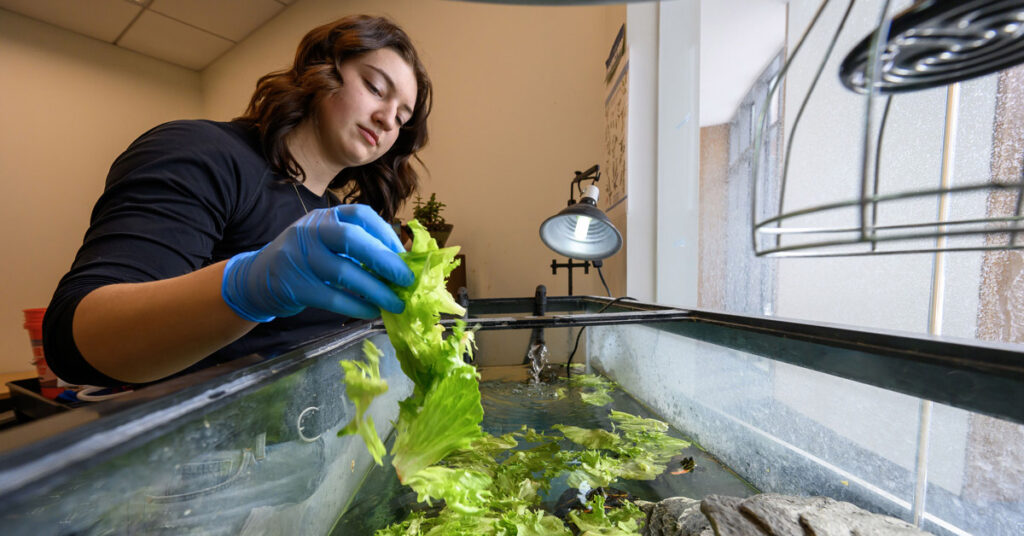
The turtles’ diet consists largely of romaine and leaf lettuce—leftover from campus dining—supplemented occasionally with freeze-dried shrimp. Once a week, the turtles are removed from the tank and placed in a lined bin to dry completely, a practice that helps prevent infection and allows time to thoroughly clean the tank.
Although MassWildlife assigns each turtle a coded identifier, Wheaton’s four residents have picked up unofficial nicknames along the way: Blue Bell, Green Jeans, Red Robin and Mellow Yellow.
Beyond husbandry, the project also contributes to ongoing research. Because the aquarium is positioned near a window, Wheaton’s turtles are part of a “natural sunlight” group, allowing researchers to compare growth rates across different light conditions. Host institutions also receive either sibling groups or mixed groups of hatchlings—without knowing which until after the study concludes.
“We’re looking at whether sibling groups grow differently than mixed groups and how that might affect reintroduction success,” Barrett said. “All of the physical parameters at each host site are kept consistent so the data is reliable.”
As the turtles grow, so does the time commitment. Early in the year, caretaking sessions might last 15 minutes; now, with larger, more active turtles, sessions can stretch to 45 minutes, Lambert-Shemo shared.
“I really rely on Emma Claire,” Barrett said. “She organizes the team and makes sure everything runs smoothly.”
For the students, the experience connects directly to their academic and career goals. Carias, who hopes to pursue a career combining conservation and education, said the role has been deeply meaningful.
“This lets me work with animals I care about while also thinking about how to communicate conservation issues to the public,” Carias said.
Williams echoed that sentiment, noting that even small contributions can have lasting impact. “Helping these turtles grow and eventually return to the wild feels like a real way to make a difference,” she said.
Now more than halfway through their time on campus, the turtles’ growth is striking. From an initial weight of about nine grams, they now average around 160 grams, with some expected to exceed 300 grams by May.
“They grow incredibly fast,” Barrett said. According to MassWildlife, turtles that complete the headstart program often reach the size of a three-year-old wild turtle before their first birthday—a dramatic boost to their chances of survival.
Long-term studies suggest the program works. Research conducted by MassWildlife and UMass Amherst found annual survival rates exceeding 95 percent in many ponds, with strong evidence of reproduction among headstarted populations.
For anyone curious to see conservation in action, the turtles can be viewed in the lower level of the Mars Center for Science and Technology, adjacent to the courtyard between Mars and the Diana Davis Spencer Discovery Center Dedicated to Free Speech and Innovation.