
Writing for impact
Course focuses on developing grant proposals
No student is required to take Grant Writing for Social Justice.
The course does not fulfill a requirement for any major, minor or program track. It’s a pure elective, one that requires a willingness to conduct a great deal of research and writing.
 “This is not a class students take because it’s easy,” said Professor of Art History Kim Miller, who designed and teaches it. “They take it because they care deeply about something—and they want to learn how to make change possible.”
Nevertheless, it’s popular. Miller is teaching the course for the third consecutive semester this spring. She also teaches an online version of the course during the college’s winter and summer terms.
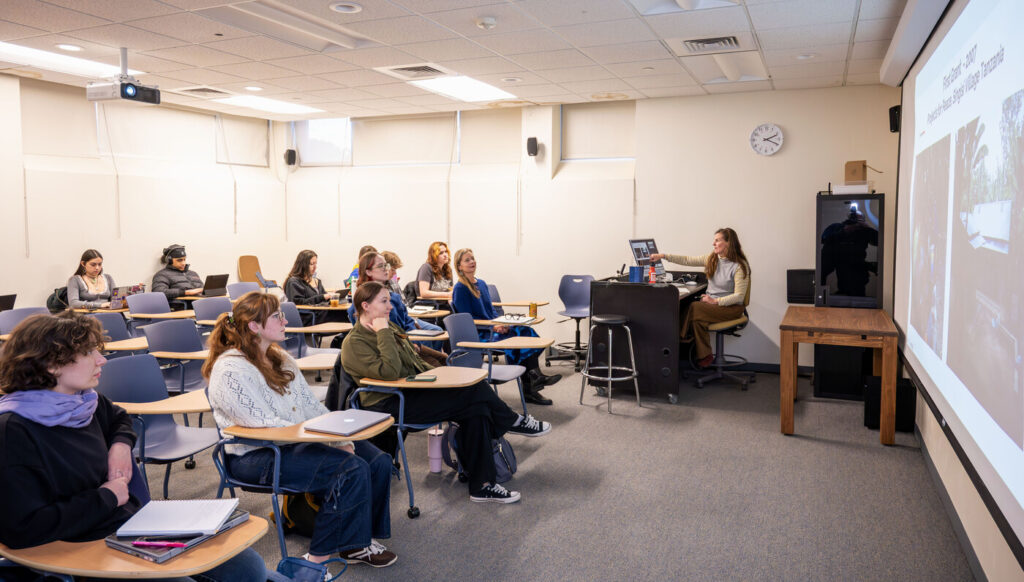
The writing-intensive course draws students from a wide variety of majors to learn the art and science of crafting grant proposals. Over the course of the semester, each student will develop a fully-formed grant proposal to support their interests in public media, museums and nonprofits, advocacy organizations and international relations.
“This class blends rigorous writing with real-world application,” Miller said. “It’s still liberal arts—but it’s liberal arts with purpose.”
Developing expertise through experience
The course reflects Miller’s academic and professional experiences, starting with her time as a Ph.D. student at the University of Wisconsin Madison, where she conducted research with women artists and activists who were active in the anti-apartheid movement in South Africa, and were using art to tell their stories from that time period.
The art historian whose scholarship now focuses on the ways that public art challenges or reinforces dominant social narratives about the past, recalls writing multiple unsuccessful grant applications before flying to South Africa with only her own meager funds to support the effort. Long before her work was done, her funds were exhausted.
“We were ready to come back home because our money had run out when I got my first grant, which allowed me to continue my work for another six months,” she said.
Since then, she has secured more than 30 grants, including the National Endowment for the Humanities, the Woodrow Wilson Foundation, the Whiting Foundation, the Department of Education, and the American Association for University Women.
“I never had formal training in grant writing,” Miller said. “I learned by doing—and by failing—until it worked. Now I get to give students what I never received.”
Students in Miller’s course build a finished grant proposal “brick by brick” during the semester—researching organizations, conducting focus groups, drafting letters of inquiry, building budgets, and rounds of drafting and revision. Along the way, they sharpen skills in research, synthesis, persuasive writing, budgeting, and project design—skills that translate well beyond nonprofit work.
Writing with purpose
While the course imparts the technical skills required for successful grant proposals, it also emphasizes the ability to promote positive change for a cause that each student cares about.
“This isn’t just about teaching students how to write grants,” Miller said. “It’s about creating a space for them to discover where they belong in the work of social change—and then equipping them with the concrete skills and knowledge to act and to advance from that place of belonging.”
Students in the course choose projects that reflect their interests, whether it be improving the efficiency of a regional food bank, expanding arts programming for disenfranchised youth or raising emergency funds for a statewide transgender advocacy organization.
“Students come to the class with their own ideas about organizations that they want to support or issues that they care about,” Miller said.” That’s one of the reasons why I love this class. I really love talking to young people about their ideas and their dreams.”
For Pryce G. ’28, a digital media and communications major with long-term plans to work in archives and preservation, the course aligned directly with her career goals. Her final project proposes funding for a paid internship program at Boston’s GBH/PBS to help digitize analog media and preserve public broadcasting archives.
“Grant writing is essential in archival work,” she said. “So many museums and archives depend on grants to survive. This class helped me understand not just how to write, but how to research an organization deeply and present an idea that fits its needs.”
That emphasis on authenticity—knowing an organization inside and out—is central to Miller’s teaching. “You can’t write a strong grant unless you really understand the work,” Pryce said. “Professor Miller cares a lot about that.”
Angus MacPherson-MacBeth ’28, who is pursuing a double major in international relations and global languages and cultures, also saw the grant-writing course an opportunity to learn a tangible skill for a future in a non-governmental organization or non-profit devoted to causes, such as supporting immigrants.
For the course, however, he chose to focus on a local organization close to his heart: Boston’s Museum of Science, addressing the museum’s recent federal funding losses that affect both its operational budget as well as ongoing renovations. In light of the drop in government funding, he chose to write a proposal targeting private donors that support the institution, such as Fidelity Investments.
“I definitely have a better idea of what it takes to write a grant now and the breadth and depth of research that goes into it,” MacPherson-MacBeth said. “It’s very different from writing the typical policy papers, position papers, and other essays that I’ve written.”
In grant writing, he said, you are marshalling research to create a compelling argument for funding a cause or project. “There’s a narrative element to a good proposal. Ideally, you’re telling a story about a problem, why it matters and how funding will help. That was new for me, and really valuable,” he said.
Real-world connections
Both students pointed to guest speakers—alumni and professionals working in fundraising and nonprofit leadership in New England—as a highlight of the course. These visits expose students to a wide range of funding models and career paths, and sometimes lead to unexpected opportunities.
Miller noted that alumni visits have, on occasion, resulted in internships or job offers for students whose project ideas align with real organizational needs.
“It happens organically,” she said. “Students are doing thoughtful work, alumni see that, and connections form.”
Long before Grant Writing for Social Justice existed as a course, Miller taught the subject one-on-one and embedded it in senior seminars as a way to help students connect academic work to life beyond campus.
In fact, one of those students, Coco Moseley ’09, visited Miller’s course in the fall to share the story of how she came to write her first grant proposal while she was an undergraduate as well as her experiences in applying for and winning more than $2 million in grants in her career in public advocacy and education.
One of the points Moseley stressed was the extent to which grant writing is often an unwritten part of many nonprofit jobs. The ability to develop funding proposals could be a skill that sets students apart from others, she said.
“You can write grants in any role you are in. I think it is something that is open to everybody,” Moseley said. “It’s a muscle you build through practice. Even if you don’t get rewarded the first time, you will have all that material from your research that you can keep working on and build a case of support for your community.”
The practical benefits of the course extend beyond the ability to craft winning grant proposals, Miller points out. Students are also further developing their skills in research, analysis, creativity and persuasive writing, which will help them no matter what they choose to do after graduation.
“You’re learning how to think strategically, how to tell a story with data, and how to communicate clearly and concisely within real constraints,” Miller said. “Those skills matter in communications, business, public policy—almost everywhere.”