
Committed to building community
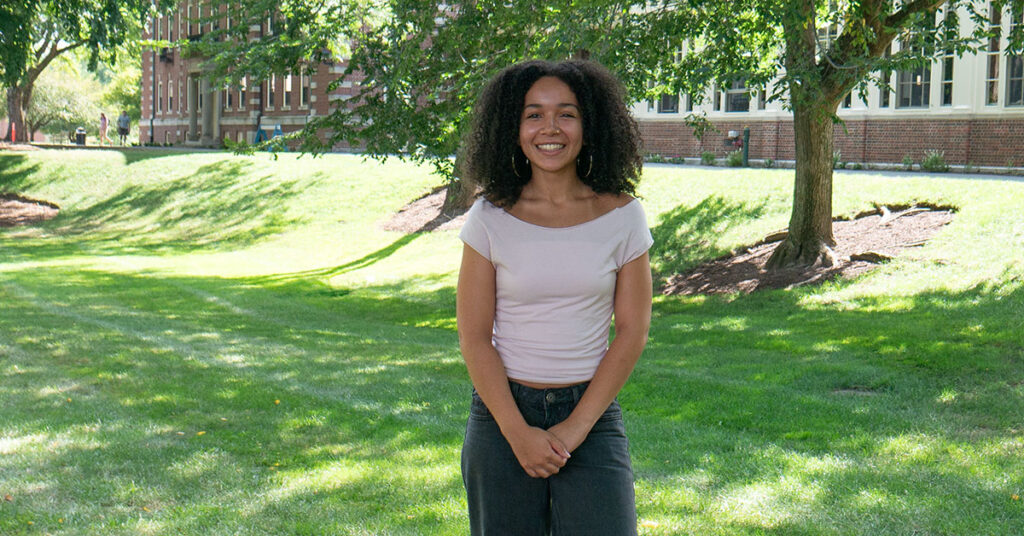
Wheaton senior wins national fellowship to promote civic engagement
When Isabella Correa ’27 began facilitating sessions for Wheaton College’s community dialogues program, she discovered that a key to fostering meaningful conversation on difficult topics is the pause before responding.
The insight changed her. “It made me a more active listener,” said Correa, a senior women’s and gender studies major. “I get really excited about certain topics, so I want to immediately share my own opinions, but I realized that to create a rich dialogue that I need to give the stage and my full attention to the people who are speaking.”
The ability to organize and lead productive conversations led to her selection as a Newman Civic Fellow for the 2026–2027 academic year. The award comes from Campus Compact, a national coalition of colleges and universities working to advance the public purposes of higher education. The organization chose student civic leaders from 39 states, Washington, D.C., and Mexico for its 2026–27 cohort.
The year-long fellowship recognizes students who demonstrate leadership potential and a commitment to creating positive change in their communities, and it supports fellows’ personal, professional and civic development.
“I’m really excited about this opportunity,” Correa said. “There will be a convening of all the Newman fellows this November in Washington, D.C., and that will be a good opportunity to make connections with other students beyond Wheaton who are interested in civic engagement. I expect to learn a lot from the other fellows.”
Being an active citizen
The senior’s interest in civic engagement and community building stretches back to childhood.
“From a young age, my mom immersed my sister and I in our community. Every block party, concert, protest and event felt like an extension of who we were,” she said. “My sister and I were raised to value our community as much as we valued ourselves, and social justice became a pillar of our lives.”
At Wheaton, she followed up on that interest by becoming involved in the Community Dialogue Series organized by the Marshall Center as a participant during her sophomore year. The next year she was offered an on-campus job as a student facilitator for the dialogues.
“It’s a great job. I find that it’s so interesting to engage in social justice conversations that are organized to help you understand other perspectives in a respectful way,” she said. “To be involved in it as a job has been such a great opportunity.”
The community dialogues program aims to help students develop their ability to participate in meaningful and respectful conversations on difficult and contentious topics with people who hold a diverse array of perspectives. Students tackle tough subjects such as banned books and censorship or immigration and migration. Rather than relying on presentations, facilitators use activities and carefully framed questions to invite participants into discussions that allow for a full and open exchange of ideas and opinions.
“When people are passionate about certain topics, it can be difficult for them to take a moment and hear each other,” Correa said. “But when there’s an intentional question, and facilitation, it creates an enlightening experience.”
Correa, who also is pursuing minors in African Diaspora Studies and history, found a similar kind of intellectual excitement in Wheaton College’s courses, which average between 15 to 20 students per class. Her studies, she said, have given her a way to better understand the world and consider how it might change.
The course “Black Feminist Thought and Action,” taught by Brown-Wheaton Faculty Fellow Damali Britton, was especially influential. Through readings by Patricia Hill Collins, bell hooks and Audre Lorde, Correa encountered scholarship that connected theory to her lived experience and centered perspectives she had not previously seen reflected in feminist texts.
“It was not only validating for me to be a part of that class and realize that this is more than a feeling, but that this actually matters,” said Correa, a Wheaton honors scholar following the college’s Taylor and Lane Social Justice Scholar pathway. “You feel empowered to speak. And you feel proud of the way that you think.”
A fast-developing opportunity
The existence of the Newman Civic Fellowship program came as a surprise to Correa. In mid-August, she received an email from Raquel Ramos, dean of the Marshall Center, and Angelica Mirandou, assistant director for campus dialogue and first-generation student success, asking if she would be interested in applying for the fellowship. They talked by telephone and then worked together to submit the application.
Two weeks later, she learned that she had been selected.
For Correa, the fellowship creates an opportunity to bring together the academic questions that motivate her and the community-centered action that has shaped her experiences before and during college.
A central component of the fellowship is a civic engagement project. Correa is still developing her plans. The Newman Civic Fellowship will also offer Correa virtual training sessions and project workshops. Fellows may apply for mini-grants to support community projects, as well as scholarships and post-graduate opportunities.
“Having the autonomy to develop a new project that is entirely my own is really cool,” she said. “A lot of the projects that I’ve done, though I’ve really enjoyed them, have been part of classes I’ve taken. There’s a lot of freedom in doing a project that I can direct from start to finish.”
For Correa, the fellowship’s combination of research, learning and civic engagement feels especially fitting as she begins her senior year and prepares for life beyond Wheaton.
“I think having both sides of that is really cool,” she said. “It’ll make me feel at home in academia, but also connected to action in the world.”