
Driven by curiosity and a passion for marine life
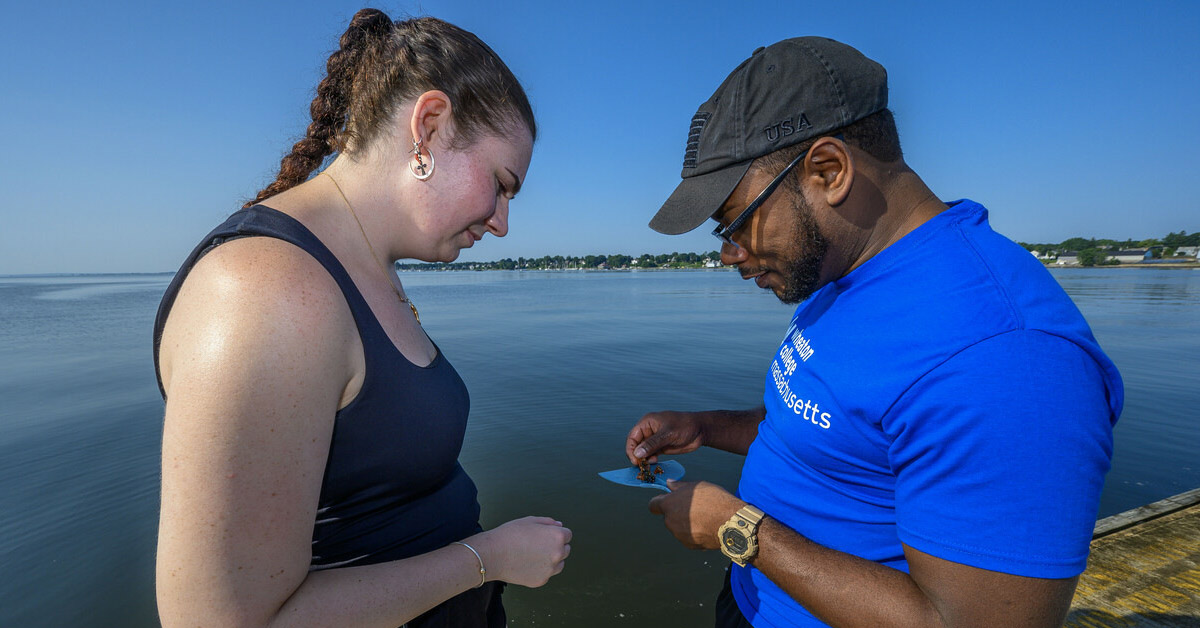
Professor Andrew Davinack researches aquatic invasive vertebrates and their infectious parasites
Andrew Davinack vividly recalls the moment he became interested in marine parasites as an undergraduate student. “I opened a clam for the first time and tried to quantify its health,” said the Wheaton College assistant professor of biology and aquatic biologist. “I noticed these little critters swimming inside and I was enthralled.”
Davinack, who began at Wheaton in 2022, still experiences and exudes that same sense of wonder and excitement in the lab, the classroom and out in the field, where he is contributing to important research to help prevent ecological damage and protect the recreational, commercial and agricultural resources provided by bodies of water in the Northeast.
His scholarship primarily focuses on invasive invertebrates and the parasites that infect them. At Wheaton, he teaches a wide range of courses, including “Principles of Parasitology,” “Invertebrate Zoology” and “Genetics.” He also runs a research lab in the Mars Center for Science and Technology that engages students in independent as well as collaborative hands-on learning that prepares them for diverse careers in the biological sciences.
Davinack most recently has been busy with two projects—the Rapid Assessment Survey of Marine Invasive Species and the Wellfleet Oyster Alliance Project. The survey, organized, in part, by the Massachusetts Office of Coastal Zone Management, is ongoing research to detect invasive aquatic species before they become a problem. In Wellfleet, he is collaborating with Cape Cod oyster farmers to address ecological and economic challenges posed by invasive worms as part of an extensive grant-funded project.
“I’m lucky that my research is connected to a lot of economic things, like the aquaculture industry, which can result in broad impacts,” he said.
“For example, DNA barcoding, which I frequently use in my lab, is being leveraged during biomonitoring surveys in order to identify potentially invasive species on the New England coast. Furthermore, my research on parasites is being leveraged to develop methods for reducing parasite load in commercially reared oysters on Cape Cod.
“I translate this applied angle into my teaching by relaying to students why a particular topic is important in a wider context. For example, understanding the basics of cell division is important because cancer is essentially caused by a malfunction in the cell division machinery so any revolutionary cancer therapy will have to address that malfunction. This provides context for students and allows them to think beyond the material presented in class.”
Drawn to water and “weird stuff”
Born in Trinidad and Tobago, Davinack was drawn to the ocean early and spent an abundance of time in coastal waters while he was growing up, which he credits with igniting his passion for marine biology. Surprisingly, when his family moved to New York City, his interest in aquatic life soared.
“I was always near Jamaica Bay,” he explained. “Despite being highly developed, Queens, New York, has salt marshes where you can find crabs and lobster.”
Davinack earned a bachelor’s degree in biology at St. John’s University, where he first studied clams harvested on the Connecticut coast, and a master’s degree in the same subject at Hofstra University, where he began his career as an adjunct instructor.
After completing a Ph.D. in zoology at Stellenbosch University in South Africa, he spent seven years as an assistant professor at Clarkson University in New York’s Adirondack Mountains, where he studied freshwater environments while longing for a more robust aquatic setting.
Educated as a marine biologist, he had to learn how the freshwater environment works.
“My research originates from a sense of curiosity and a fascination with weird stuff. I was out of my element studying freshwater, but it allowed me to explore new aquatic habitats.”
When an opportunity to teach at Wheaton arrived, Davinack eagerly took it. He especially relished working near saltwater. (Rhode Island, the Ocean State, is a 30-minute drive from campus.)
“The move here put me back into my element, near the ocean,” he said.
Teaching and conducting research at Wheaton
Under Davinack’s mentorship, students gain hands-on experience and contribute to his research. Two students also have contributed to peer-reviewed scientific articles in Aquaculture and BioInvasions Records.
By focusing on skill-based learning, students acquire experience with techniques applicable to real-world settings, like at a biotech company, he said. And they can do things several times and learn from their mistakes.
“We use a lot of genetic techniques in my lab, which take a month at most to train a student to use,” he said. “Once we do that, they take charge of the project.”
Ava Sheedy ’25, an anthropology major from Gloucester, Mass., after taking Davinack’s “Introduction to the Biological Sciences” course and learning about his research, enrolled in his “Research Experience (DNA Barcoding)” course.
“It was my first real lab experience and such a welcoming environment,” said Sheedy. “I gained the confidence to ask questions, developed my skills and was eager to become more involved.”
Sheedy decided to add biology as a second major and was so intrigued by DNA barcoding and the world of genetics that had been opened to her, she joined Davinack’s lab.
“Professor Davinack talks to you in the lab like you’re one of his peers. He has confidence in your skills and that helps grow your self-confidence,” she said.
Rapid Assessment Survey of Marine Invasive Species
In August, Sheedy joined Davinack at three coastal Rhode Island locations for his participation in the Rapid Assessment Survey of Marine Invasive Species.
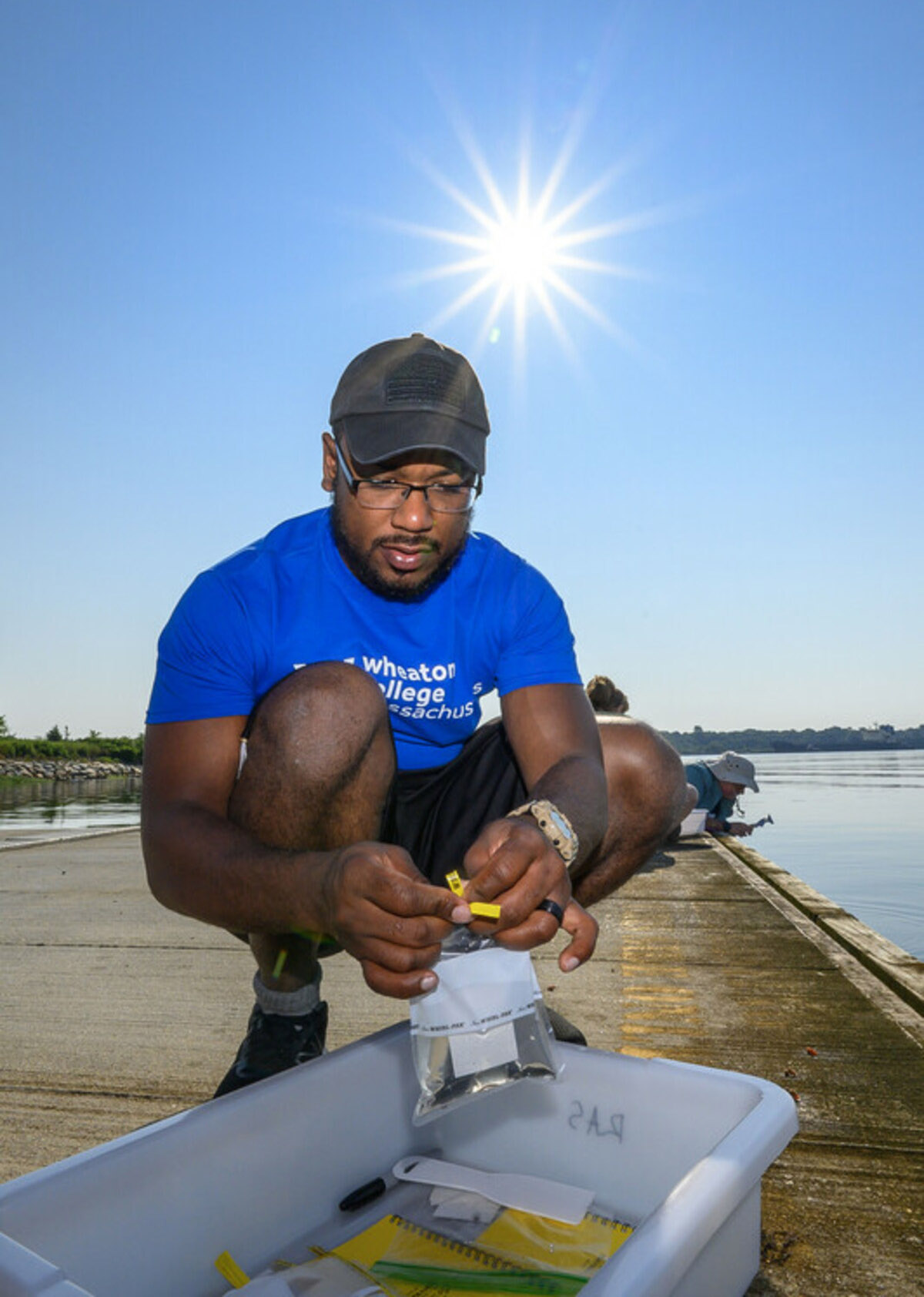
“Joining the survey team gave her a more intimate idea of how the process works,” said Davinack. “Most students don’t get to see live animals because DNA work doesn’t require it. Ava saw a lot of these organisms alive.”
Every few years, a team of scientific specialists visit marinas along the New England coast to observe, identify and record marine organisms. They spend an hour at each site examining submerged surfaces. Samples are collected and later identified in a laboratory.
“We can spend from six to 12 hours identifying every organism down to the species level,” Davinack said. “We’re beginning to detect things that should not be here. They’ve been typically found in the Mid-Atlantic, but now they’re getting close to New England.”
If non-native species overpopulate an area, they can disrupt the ecosystem, food chain and prosperity of native species. It can be expensive or impossible to remove invasive species, Davinack said.
He notes that most introduced species rarely become invasive because the habitat may not be suitable for them, but some have survived.
“We have the European green crab here. It’s invasive in the northeast. They can displace native crabs by outcompeting them for food,” he said.
Today, if an invasive species is detected, the Massachusetts Office of Coastal Zone Management is notified. If necessary, it will begin an eradication process.
Wellfleet Oyster Alliance Project
In addition to the survey, this spring Davinack began a project in Wellfleet, Mass., a Cape Cod town well-known for its oyster harvest operations and for hosting the annual Wellfleet OysterFest in October.
He is researching polychaete worms that burrow into oysters. “That’s a problem for oyster farmers,” he said. “Ecological and economic problems can arise by having an invasive come in, depending on the type of species.”
With grant funding from the Wellfleet Oyster Alliance, he is building upon a study he conducted last year, which found an infestation of worms in the oysters harvested from one area of Wellfleet Harbor. The project involves sampling these oysters for one year and will be the most extensive continuous study of mud-blister disease in oysters undertaken on the East Coast.
“Climate change and diseases are two of the major issues with shellfish farming today,” he explained. “The worms I study can burrow into the shell. That causes the oysters to have to redistribute energy from growing to repairing itself and they don’t get to market size.”
A dam built in Wellfleet Harbor’s Herring River Estuary has prevented tidal flushing (flow going in and out), which has resulted in high levels of bacteria, according to Davinack. His 2023 study revealed that every oyster in the area was infected.
Wellfleet officials are removing the dam to restore tidal flow and the grant will enable a replication of the study to see whether the parasite load will decrease. Each month from May 2024 until May 2025, Davinack is analyzing the oysters’ infection levels.
He hopes to find a window of time when an intervention could eradicate the worm. If so, with additional funding, Davinack said he may be able to use a chemical called Mebendazole.
“It’s used in human and veterinary medicine to get rid of worms, so we’re going to trial that drug on oysters in the lab to gauge its effectiveness,” he said.
Meanwhile at Wheaton, Davinack continues his research into the clams that fascinated him as an undergraduate. He enjoys passing on what he has learned to his students while imparting the sense of curiosity and wonder that often fuels the passion of research